

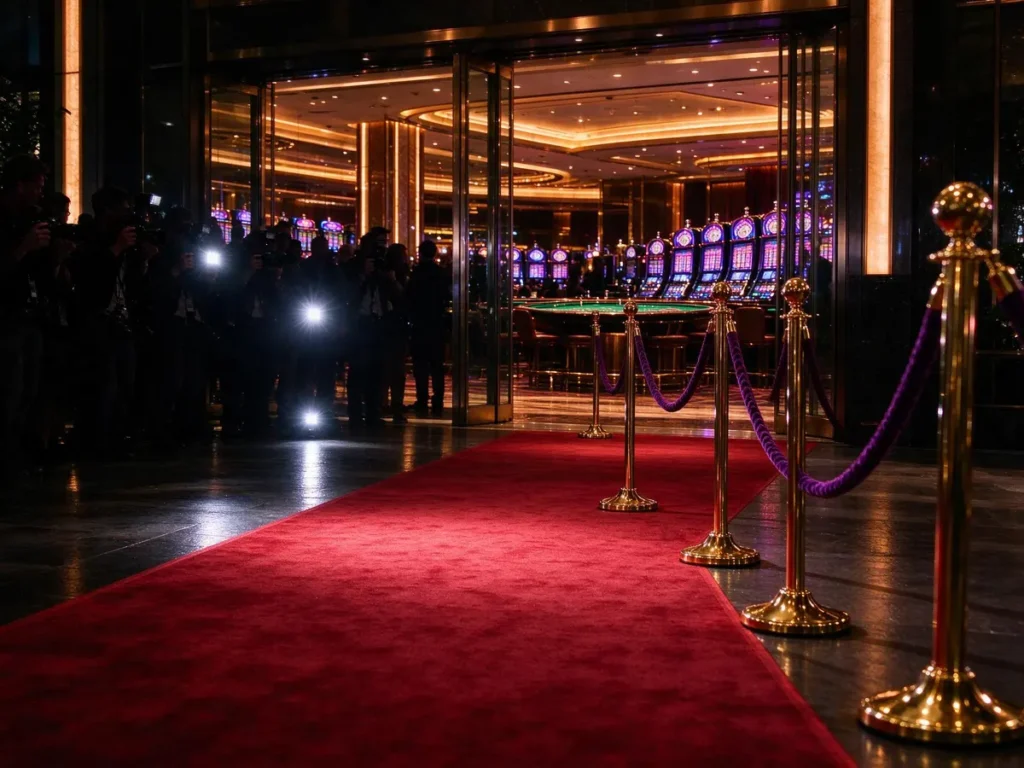
Why fly a 1980s American TV star to a casino opening in North Rhine-Westphalia?
Because the plane ticket is cheaper than the press coverage it buys. Celebrity casino grand openings have become a standard play in land-based gaming marketing: book a recognisable name for launch night, and a regional venue opening turns into a story that travels beyond its own catchment area.
The latest example is Merkur Spielbank Siegburg. According to trade coverage from G3 Newswire, the new German casino is scheduled to open to the public on 10 December 2026 with a three-day opening party running to 12 December, and the first evening features Patrick Duffy, known worldwide as Bobby Ewing from Dallas, travelling from the United States for the occasion. He is accompanied by Linda Purl, an American actress; sources variously describe her as his wife or his partner.
That is the news. The more interesting question is what a booking like that is actually supposed to achieve, and how much of the claim around it can be backed with numbers.
The Siegburg numbers, and what they actually say
Merkur Group is putting approximately €35 million into Siegburg, which will be the sixth state-licensed casino in North Rhine-Westphalia. The figures published alongside the announcement describe a mid-sized regional venue rather than a destination resort.
| Detail | Figure (per operator, via trade press) |
|---|---|
| Investment | Approximately €35 million |
| Playing space | Around 1,600 square metres |
| Slot machines | Around 250, latest generation |
| Table games | Classic roulette and card tables |
| Jobs created | Around 100 |
| Build time | About 21 months, from the March 2025 groundbreaking to the 10 December 2026 opening |
| Opening programme | Three days, 10 to 12 December 2026 |
Read those figures honestly and they support exactly one conclusion about the celebrity element: none. There is no published cost for the Duffy appearance, no projected attendance for opening weekend, and no stated target for how many of those visitors the booking is meant to deliver. The €35m is capital expenditure on a building and a gaming floor. The actor is a line item nobody has disclosed.
What the operator has said is about intent rather than return. Live entertainment, in the company’s words, “is part of the DNA of Merkur Spielbanken”. That is a positioning statement, and it is worth taking at face value: the celebrity booking is being presented as an expression of what the venue will be, not as a one-off stunt.
Why star power earns its slot on launch night
A celebrity converts a local business story into a national one. That is the whole mechanism, and everything else follows from it.
The press pickup you cannot buy directly
A new casino with 250 machines and 1,600 square metres of floor space is, editorially speaking, a property story. Local papers cover it, trade titles cover it, and that is usually where it stops. Add a name an entire generation recognises from prime-time television and the same event acquires a photo desk angle, a nostalgia angle, and a reason for consumer outlets to run it at all.
Paid advertising reaches the people you target. Earned coverage reaches the people who were not looking, which for a venue trying to establish itself in a competitive licensed market is the harder audience to buy.
Nostalgia as a shortcut to trust
Recognition transfers faster than reputation. A brand-new casino has no track record with its local audience, no word of mouth, and no memory attached to it. Borrowing a figure the target demographic already feels warmly towards is a way of skipping the slow part. Dallas aired at a time when much of the German casino-going audience was watching it, which makes Duffy a precise demographic match rather than a generic famous person.
The limit of this logic is obvious once you say it out loud: the association is with the opening night, not with the product. Nobody returns to a roulette table in March because of who stood on a stage in December.
Hollywood and casinos: an old arrangement, not a new one
Casinos have used entertainers to build identity since the mid-twentieth century, and the Las Vegas casino history that most of the industry’s marketing instincts descend from was built on exactly that arrangement. Showrooms and resident performers were how properties on the Strip differentiated floors that otherwise offered the same games at the same odds. Anyone writing about that era should source the specifics to a reputable history of the market rather than rely on the folklore, but the broad pattern is uncontested: entertainment was the differentiator when the gambling itself could not be.
Seen that way, a Patrick Duffy casino appearance in Siegburg is not an innovation. It is a regional, budget-scaled version of a tactic the industry has run for seventy years, applied to a market where live entertainment licences, venue capacity and regional media are the variables rather than Strip real estate.
Is this a measurable trend, or a familiar habit?
Honest answer: the practice is clearly widespread, but I have not seen a public dataset that tracks how many land-based casino openings feature a celebrity, or how that share has changed. Anyone claiming a hard percentage is guessing.
What can be said without overreaching is that celebrity and entertainment tie-ins at venue launches are common enough across markets to be unremarkable, and that operators keep repeating them, which is its own kind of evidence. Businesses rarely re-run a marketing tactic for decades without internal numbers that justify it. Those numbers are simply not published, and the ones that are published are hard to read: casino revenue moves with regulation, tax, tourism and local competition all at once, which is why a single market’s revenue swing rarely proves what people claim it proves”>single-market revenue figures make poor evidence for any one marketing decision. If you want proof that an actor on a stage drove footfall, the industry does not hand it to you.
What the operator gains, and what it is risking
The upside is attention at the precise moment a venue needs it; the risk is paying for attention that does not survive the weekend.
Upside: attention and footfall
- Earned media coverage in outlets that would not otherwise run a venue story.
- Social content from attendees, which extends the opening beyond its three days.
- Differentiation from competing licensed venues offering identical games.
- Staff and community goodwill around a launch that also created around 100 jobs.
Downside: cost and the style-over-substance problem
- Appearance fees, travel, production and security are real costs with no guaranteed return.
- A mismatched name reaches the wrong demographic and reads as desperation rather than confidence.
- Launch-night glamour sets an expectation the regular gaming floor has to meet on an ordinary Tuesday.
- Glamorising gambling through celebrity association sits awkwardly with responsible gambling messaging, which is why the sober parts of the operation, deposit and session limits, self-exclusion, staff trained to spot harm, matter more on a busy opening weekend, not less.
The substance risk is the one I would watch. A venue that spends €35m on a floor and then wins its headlines on the strength of a guest appearance has told the market that the floor was not the story. For one weekend that trade is probably worth making. As a repeated strategy it quietly concedes the point.
Where this goes next
Land-based venues are competing for attention with online products that can be opened on a phone in four seconds, and the one thing a building can offer that an app cannot is a reason to physically be somewhere. That is the structural argument for entertainment-led marketing, and it is why celebrity casino grand openings will keep happening regardless of whether anyone publishes the attribution data.
What remains genuinely open is whether the tactic still works on audiences younger than the ones it was designed for. A name from Dallas lands with people who watched Dallas. Which names land with everyone else, and whether a photo opportunity on launch night still converts to anything in a feed-driven attention market, is the question operators are answering with their booking budgets rather than their press releases.
If gambling stops being entertainment for you, use the deposit, loss and session limits your operator provides, or the self-exclusion options available in your jurisdiction.