

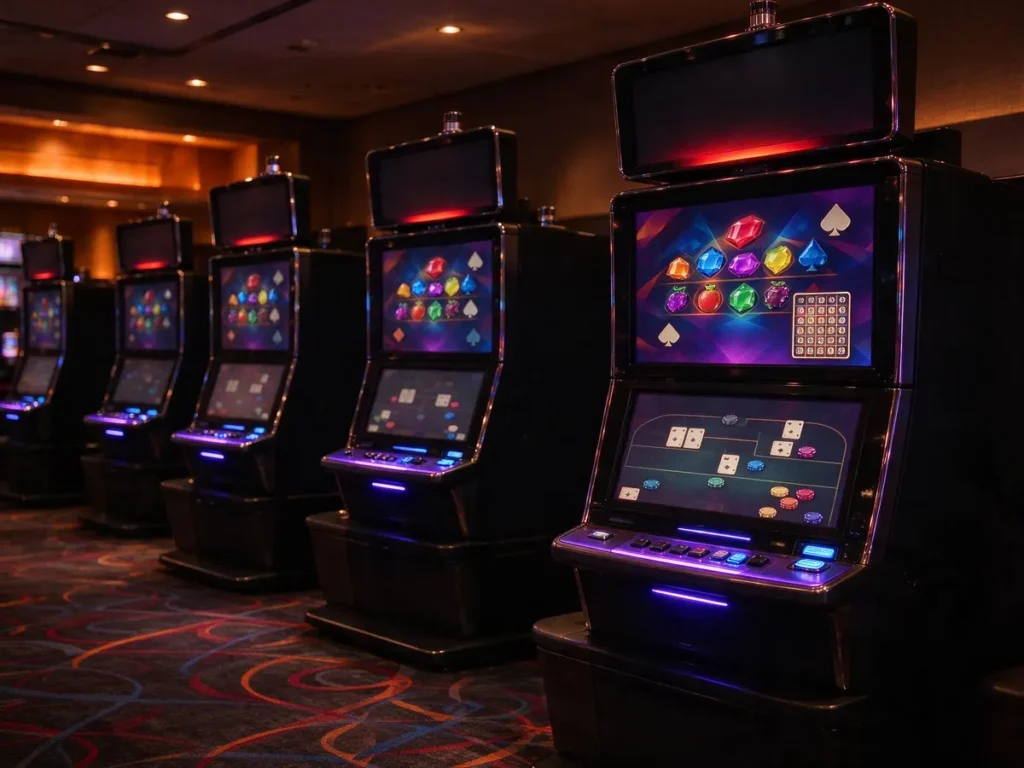
The machine you just sat down at in a tribal casino is not a watered-down slot, and it is not rigged against you because of the sticker on its glass. Class II slot machines are electronic bingo games dressed as slots — the reels you watch are a display of a bingo result that has already been decided, not an independent random spin. That difference comes from federal law, specifically the Indian Gaming Regulatory Act, and not from a secret decision to pay less.
The distinction matters more this month than usual. Aristocrat Gaming is taking Monopoly Big Board Bucks, which won Slot of the Year at the Global Gaming Awards Americas as a Class III game, into Class II markets across the United States. That is a premium branded title crossing a legal boundary most players have never had explained to them. So here is the explanation, including the part the internet usually gets wrong.
What a Class II slot machine actually is
A Class II slot machine is an electronic aid to a bingo game, legally classified under the Indian Gaming Regulatory Act (IGRA) of 1988 alongside bingo, pull-tabs, instant bingo, punch boards and non-banked card games. It is not a slot machine in the legal sense at all. Tribes can offer Class II gaming without a compact with the state, under tribal regulation with oversight from the National Indian Gaming Commission.
The legal line is narrow and it has been fought over in court for decades. An electronic aid to bingo is Class II. An electronic facsimile of a game of chance — a machine that is the game itself rather than a tool for playing a shared one — is Class III. Everything about how Class II cabinets are built flows from staying on the right side of that sentence.
How the outcome is decided before the reels spin
When you press the button on a Class II machine, you are buying into a bingo game run by a central determination system. The server draws numbers, daubs your card against the pattern, works out whether you won and how much, and then sends that result to your cabinet. The spinning reels, the near-miss, the bonus trigger — all of it is presentation layered on top of a bingo outcome that already exists.
Two consequences follow. First, the outcome comes from a bingo draw rather than an independent RNG in your cabinet, though on modern electronic Class II machines no actual second human participant is needed: the server runs the ball drop and evaluates the card regardless of who else is playing. Second, the prize structure is tied to the bingo game’s pattern wins rather than to a reel combination evaluated in isolation. A Class III slot evaluates your spin alone with an RNG and pays from a fixed paytable. A Class II game sorts the cards in play and pays the patterns that hit.
Class III gaming: the Vegas-style standard, and what it costs a tribe to offer
Class III gaming covers everything that is not Class I or Class II: RNG slot machines, house-banked blackjack, craps, roulette, baccarat and lottery games. A tribe can only offer it under a tribal-state gaming compact negotiated with the state and approved by the Secretary of the Interior. No compact, no Class III, however much the tribe or its players might want it.
That approval requirement is the whole story behind Class II floors. Compacts take years, involve revenue-sharing terms and scope limits, and in some states have stalled or been litigated repeatedly. A tribe in that position is not choosing an inferior product for fun; it is running the only category of machine gaming it can lawfully run.
| Point of difference | Class II | Class III |
|---|---|---|
| Legal basis | Bingo and bingo-like games under IGRA | All other casino-style gaming under IGRA |
| State approval | Not required | Tribal-state compact required |
| Primary oversight | Tribal gaming authority with NIGC | Tribal authority plus compact terms with the state |
| How outcomes are set | Central determination, bingo draw and daub | Independent RNG result per spin |
| Who you play against | The bingo game on the central server, with any other cards in play | The house, individually |
| Real money | Yes — cash in, ticket out | Yes |
Why Indian gaming regulations split machines into classes at all
IGRA was Congress’s answer to a 1980s standoff over whether states could police gaming on tribal land. The three-class structure was the compromise: traditional and social games (Class I) stay entirely with the tribe, bingo-derived games (Class II) stay with the tribe under federal oversight, and casino games that states have the strongest interest in regulating (Class III) require the state to sit at the table.
So the class of a machine tells you about the jurisdiction that signed off on it, not about its quality. The NIGC publishes technical standards and minimum internal control standards for Class II gaming systems, and those systems are laboratory-tested before they reach a floor. “Unregulated” is the one thing Class II is not.
Monopoly Big Board Bucks crosses into Class II markets
According to G3 Newswire’s report on the announcement, Aristocrat Gaming is bringing Monopoly Big Board Bucks to Class II markets across the US after the Class III version won Slot of the Year at the Global Gaming Awards Americas. Kurt Gissane, Aristocrat Gaming’s Chief Commercial Officer for the Americas, pointed to the title’s “innovative gameplay, larger-than-life bonus experience, and proven performance on casino floors” as the reason for widening its reach.
No release window, no named properties, no cabinet counts have been published that I have seen, so treat the timing as open. What the move does tell you is commercial: suppliers now see enough return in Class II markets to re-engineer a flagship licensed brand for a different legal architecture, which is not a cheap exercise.
Why a Monopoly slot machine travels well across the class line
Monopoly works on a Class II floor for the same reason it works anywhere: the board, the tokens and the big-board bonus are a presentation layer, and the presentation layer is exactly the part Class II leaves alone. The math model underneath has to be rebuilt around bingo patterns, but the player-facing experience does not.
That is the strategic read worth taking from this news. Players in compact-less markets have spent years watching marquee titles arrive everywhere else first. Suppliers are closing that gap.
Does a Class II game feel different under your hands?
Mostly no, and this is where I will part company with the common claim. Plenty of forum posts and even some gaming coverage state flatly that Class II machines pay worse. The honest position is that the mechanism differs and the payback is set by the operator and the game’s math model within regulatory requirements, not fixed at a lower level by the class itself. Both classes carry a house edge. Neither returns more than it takes over the long run.
What you can genuinely notice, if you are paying attention:
- A bingo card, ball draw or pattern indicator tucked into a corner of the screen, sometimes only on a secondary display.
- Slightly different pacing on older cabinets, where the server has to resolve the bingo game before the reels can resolve. Modern hardware makes this imperceptible.
- Prize distribution that can cluster differently, because wins are awarded against bingo patterns in a shared game rather than evaluated spin by spin.
- Progressives built on pooled contributions much as they are in Class III, though the pools and the qualifying rules differ. If you want the mechanics of how those meters build and trigger, that is covered in our piece on how progressive jackpot payouts build up and trigger”>progressive jackpots.
The weaker but still defensible counter-reading is that the pooled structure, finite prize schedules and historically thinner competition in Class II-only markets give operators less pressure to run generous paytables. That is a plausible market argument. It is not a legal fact, and I have seen no published national comparison of Class II versus Class III payback that settles it. Treat anyone who quotes you a precise figure for “Class II RTP” as guessing.
How to spot and play Class II machines at a tribal casino
Look at the help screens and the glass. Class II cabinets are generally identified somewhere in the machine’s information pages, and many carry a bingo card graphic on screen during play. Beyond that:
- Open the help or info menu and read the game rules screen, which states how outcomes are determined.
- Ask the floor attendant or the cage. Staff at Class II-only properties answer this question constantly and will tell you straight.
- Read the paytable, because it still governs what you are paid. The displayed prize schedule applies regardless of class.
- Check whether the property runs a mixed floor. Some tribes operate both classes in the same building under their compact.
And the part that applies to every machine on every floor: set the amount you are willing to lose before you sit down, and treat the session as entertainment you are paying for. Nothing about understanding the Class II mechanism gives you an edge over it — central determination is as indifferent to your timing as an RNG is. If gambling has stopped feeling like entertainment, the National Council on Problem Gambling runs the 24/7 National Problem Gambling Helpline at 1-800-MY-RESET.
The open question is not whether Class II games are legitimate. They are tested, regulated and pay real money. It is whether the compact-free path stays a workaround or becomes a market suppliers build for on purpose. Aristocrat porting its Slot of the Year across the line suggests the second answer is winning, and if you have been avoiding Class II cabinets on principle, that principle is getting harder to defend. Learn more in our explainer on Class II slot machines and Aristocrat’s new Monopoly title”>breakdown of the Monopoly release.