
What “think globally, deliver locally” actually commits CreedRoomz to
Does a studio’s slogan tell you anything useful about the games you end up playing? In this case, a little, and less than the phrasing suggests. “Think globally, deliver locally” is the principle Armen Mnaskanian, CreedRoomz’s VP of global sales, used to describe the company’s approach in an interview with Focus Gaming News: build a core game concept once, then adapt how it is delivered in each market it enters. Which means the CreedRoomz casino games an operator lists in Brazil and the ones it lists in, say, the Baltics may share a rulebook and almost nothing else above it.
That is the claim. The honest caveat is that it is also close to a default position in this industry. Pick any live casino supplier’s press cycle from the last three years and you will find a version of the same sentence. Taken alone, it is unfalsifiable. The parts of the interview worth weighing are the specifics attached to it, because those are the bits that can actually be checked against an operator’s lobby later.
Where CreedRoomz sits among live casino game studios
CreedRoomz is a supplier of live dealer and interactive casino content, selling into operators across multiple regions rather than running a consumer-facing casino itself. Mnaskanian’s remit, global sales, is itself a clue to the business model: the studio’s customers are operators, and the product is a stream plus an integration, not a brand players consciously choose.
Beyond that, treat company history as something to verify rather than assume. The interview covers strategy, partnerships and expansion plans into 2026; it is not a corporate profile, and I am not going to fill the gaps with plausible-sounding founding dates. Among live casino game studios the category is crowded and the tiers are real: a handful of suppliers dominate lobby real estate, and everyone else competes on differentiation, which is exactly the pressure the localization story answers.
The global half: one concept, built to travel
The global layer is the part of a game that does not change: mechanics, maths, round structure, show format, and increasingly the intellectual property wrapped around it. Design it once, certify it once, and the marginal cost of entering the next market is a translation job rather than a new product.
Mnaskanian’s framing of where the category is heading matters more here than the slogan. He describes live casino moving away from traditional table games and toward interactive entertainment that blends sports, entertainment and game-show mechanics. That shift is what makes a global game studio strategy coherent: a baccarat table is already globally legible and barely needs a concept, while a game show needs a format, and formats are the thing that licenses well across borders. Television worked this way for decades before iGaming borrowed it.
The partnerships sit in this layer too. The interview presents CreedRoomz’s association with Ronaldinho and its rights to the Maradona name as part of the approach. Note the slight paradox: those are global names being used to buy local resonance. Ronaldinho and Maradona do not mean the same thing in São Paulo, Buenos Aires and Tallinn, and that asymmetry is the point. The asset is global; the weight it carries is intensely regional.
The local half: what actually changes market to market
The local layer is presentation, and presentation is where almost all the recurring cost lives.
Language, hosts and presentation
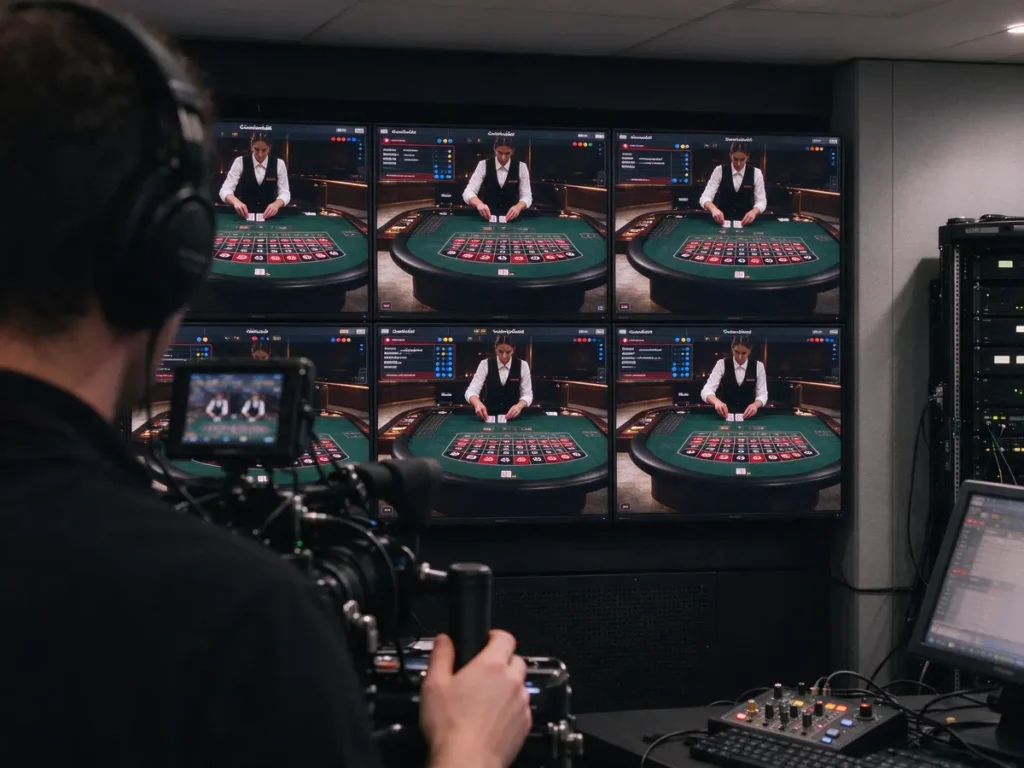
Native-language dealers and presenters, localized interfaces, regionally tuned studio sets and cultural references are the standard levers for interactive casino content, and they are expensive in a way the global layer is not. A format is a one-time build. A native-speaking host on shift across a day’s trading is a permanent line item, repeated per language. Market-specific hosts are the clearest signal a supplier is serious about a region rather than ticking a box, because nothing else in the stack costs as much per market.
Where the interview stops short of specifics, I would rather say so than extrapolate. It establishes localization as the operating principle and lists partnerships as part of the delivery; it does not publish a studio-by-studio, language-by-language inventory. Anyone evaluating the claim should ask the commercial team for that list directly.
Market and regulatory considerations
Licensing determines what can ship before taste does. Certification regimes, permitted game types, advertising rules and local partnership requirements all decide whether a format reaches a market at all, and in what shape. A game-show concept with a celebrity attached runs into marketing restrictions in some jurisdictions that it never encounters in others. “Deliver locally” is, in practice, as much a compliance workflow as a creative one.
Why localization is suddenly the talking point for casino content providers
Because the easy differentiation ran out. When every lobby carries the same roulette, blackjack and baccarat variants from the same few suppliers, the remaining levers are format novelty and regional specificity, and both are harder to copy overnight than a new side bet. Regulated markets have also fragmented: more jurisdictions, more licences, more local operators who want content that does not look imported.
So the strategy CreedRoomz describes is less a unique insight than a read on where the competitive floor now sits. The defensible counter-reading, which I do not think is stupid, is that the slogan understates real engineering: standing up studios, staffing shifts and clearing certification in a dozen markets is genuinely hard work that marketing language flattens into a phrase. Both readings can hold. I lean toward the first, because the slogan is free and the studio build is not, and only one of those shows up in a lobby.
What reaches the operator’s lobby, and the player’s screen
Concretely: a localization-led supplier means some markets get a dedicated, native-language table or show while others get the same table with a translated overlay and a non-native host. Players notice the difference immediately, usually without being able to name it. Session length and repeat play respond to it, which is why operators pay for it.
One thing localization does not touch is the maths. A native-language host, a familiar set and a recognisable face change the presentation of a game; they do not change its rules, its RTP or the house edge built into them. A localized baccarat table pays exactly what the global one pays. Treat the atmosphere as production value, not as an indicator of better odds, and keep any play within limits you have set in advance.
The test of the strategy arrives later, in lobbies rather than interviews. If CreedRoomz casino games turn up in two years as genuinely distinct market builds with their own hosts and formats, the principle held. If they turn up as one show with subtitles, it was positioning. The interview, on its own, cannot tell you which.