

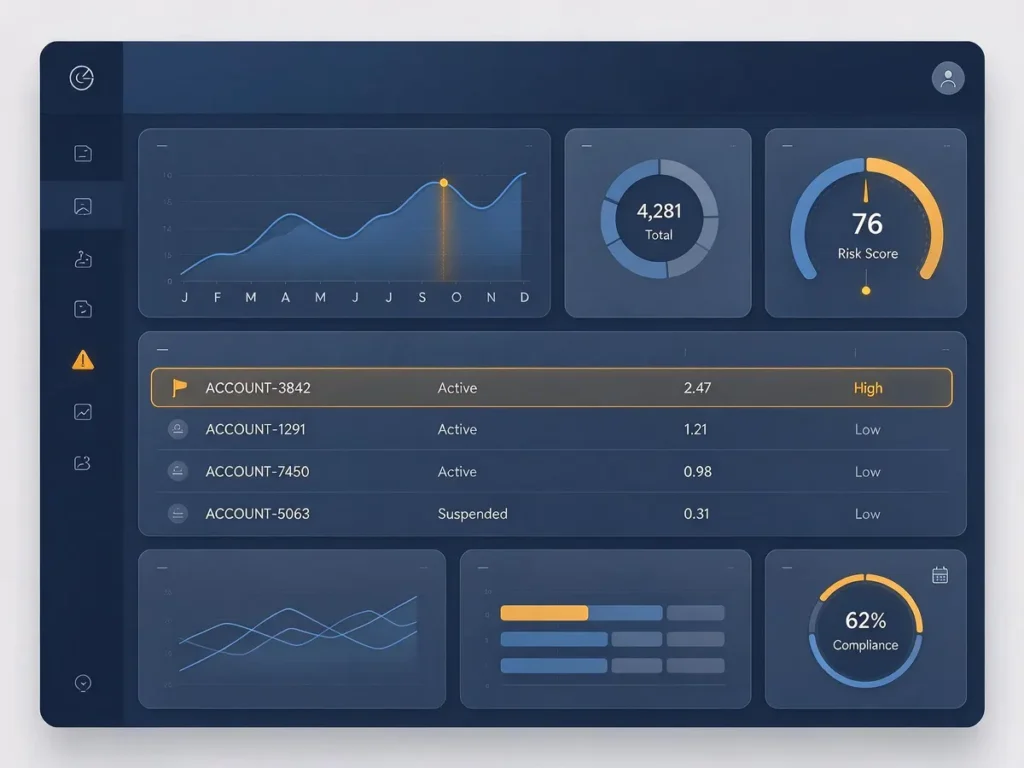
What a problem gambling detection tool actually is
Problem gambling detection tools are software systems that monitor an account’s deposits, bet sizes, session length and timing, then flag the ones whose behaviour looks like harm rather than entertainment. That is the clean definition. The messy part is that the phrase gets attached to a second, completely unrelated category of software, and the mix-up shapes how most people understand what their sportsbook is watching.
Licensed operators run two separate monitoring stacks. One looks for harm to the player: loss chasing, escalating deposits, 4am sessions. The other looks for harm to the sport: insiders betting on their own games, odd line movement, accounts that shouldn’t exist. Both of them “flag bettors”. Only one of them is about you.
Which brings us to the news that prompted this piece, and to the reason the popular answer (“yes, sportsbooks absolutely monitor you”) is correct for the wrong reason.
What OLG actually added to PROLINE
The Ontario Lottery and Gaming Corporation added integrity monitoring and prohibited-bettor detection tools from Integrity Compliance 360 (IC360) to its PROLINE sportsbook. According to the vendor and OLG, the agreement covers both online and retail sportsbook operations, which run on Kambi’s omnichannel technology, and bundles three services: an integrity monitoring dashboard, a product called ProhiBet, and one called Bad Actor. The latter two are deployed across sportsbook operations generally, retail and online alike, and elsewhere across prediction market platforms as well, rather than being confined to digital betting.
OLG’s stated purpose is to identify and report suspicious betting patterns, enforce wagering restrictions, and help sports organisations identify people who must be barred from betting. IC360 says OLG is the first government agency in Ontario to adopt Bad Actor, which targets threats and harassment aimed at athletes.
Read that again and notice what is absent. Nothing in that description is a responsible-gambling tool. “People who must be barred from betting” means athletes, coaches, officials and team staff, not customers with a deposit problem. The headlines read like a crackdown on risky punters. The purchase order reads like sports integrity. Both kinds of system exist at most regulated operators; this particular announcement is about the second kind.
So how does the software decide you are at risk?
Player protection software scores accounts on observable behaviour and on identity matches, and the two work very differently. Vendors do not publish their models, so anything written about the exact weightings is guesswork. What the industry describes publicly, and what regulators require, falls into two buckets.
Behaviour and spending signals
The behavioural side is pattern analysis on data the operator already holds, because you generated it. The signals commonly described in responsible-gaming frameworks include:
- Deposit frequency rising sharply, especially multiple top-ups within a single session
- Bet size escalating after losses, the closest thing to a measurable loss-chasing signature
- Session length and time of day, with overnight play weighted more heavily
- Cancelled withdrawals, where a player requests a cashout then reverses it to keep betting
- Failed deposit attempts, which can indicate a payment method hitting its limit
- Sudden changes against the account’s own baseline, which matters more than any absolute figure
Those inputs feed a risk score. A score crossing a threshold triggers something, and what it triggers depends on the operator and the regulator: an automated message, a prompt to set a deposit limit, a human review. Affordability checks, where an operator asks for evidence of income before allowing further play, are a routine part of this in the UK and far less common in US markets.
The structural weakness is timing. Scoring systems work on accumulated history, which means they are good at describing a problem that has already been running for weeks. Operators face the same lag in their anti-fraud work, where checks that only fire at cashout catch abuse after the damage is done.
Matching you against lists
The second bucket involves no behavioural inference at all. It is identity matching: the name, date of birth, address and documents you submitted at KYC verification, cross-referenced against registries of people who are not allowed to bet. Geolocation tracking sits alongside it, confirming you are physically inside a state where the operator is licensed.
This is the mechanism behind prohibited-bettor products. A sports governing body supplies a list of people barred from wagering, the operator supplies its customer identities, and the system reports matches. Done properly, the comparison happens without either side handing over its full database in readable form. Match found, bet blocked, report filed. No risk score, no judgement call, no appeal to how you have been playing.
A prohibited bettor list and a self-exclusion list are not the same thing
A prohibited bettor list bars people from betting because of who they are; self-exclusion bars people because they asked to be barred. The practical differences matter if you are ever on either one.
| Prohibited bettor list | Self-exclusion | |
|---|---|---|
| Who initiates it | Operator, regulator or sports governing body | The player |
| Who it covers | Athletes, coaches, officials, team and league staff, people barred by a regulator | Anyone who enrols voluntarily |
| Typical duration | As long as the role or the ban stands | A fixed term chosen at enrolment, commonly one year, five years or lifetime, varying by state |
| Scope | Operators and markets covered by the agreement | Usually all operators licensed in that state |
| Coming off it | Decided by the body that imposed it | Only at the end of the term, often requiring a formal request; lifetime terms are generally final |
The asymmetry is the point. One list is enforcement. The other is a commitment device you build for yourself, and the reason it works is precisely that you cannot undo it on a Saturday afternoon.
Do US sportsbooks run the same checks?
Yes, though the architecture is state by state rather than national. Every licensed US sportsbook performs KYC verification and geolocation tracking before accepting a wager, and responsible gambling tools such as deposit limits, loss limits, session timers and cooling-off periods are standard licence conditions in regulated states. Many states that permit online sports betting also run a voluntary self-exclusion program administered by the state gaming regulator, covering all operators licensed there.
What the US does not have is a single federal self-exclusion register. Enrolling in one state generally does not exclude you in another, which is a real gap for anyone who travels or lives near a border. Check your own state regulator’s site for the current program terms, and the National Council on Problem Gambling for the national picture, rather than trusting a figure from a betting blog.
What happens when your account gets flagged
Most flags produce a message, not a ban. The realistic sequence runs: an automated score crosses a threshold, a responsible-gaming team member reviews the account manually, and the operator applies a response proportionate to what it sees. In ascending order that usually means an in-app prompt or email, a suggested or imposed deposit limit, a temporary cooling-off period, a request for documentation, then suspension or account closure at the far end.
Can you be banned from a betting app? Yes. Every operator’s terms reserve the right to restrict or close an account, and regulators in several jurisdictions require them to act when harm indicators are clear. Being flagged for responsible-gaming reasons is not a fraud accusation and does not normally forfeit your balance, though accounts closed for suspected prohibited betting or integrity breaches are handled under a different, far less forgiving process. If you believe a restriction is wrong, the route is the operator’s support channel first and the state regulator’s complaints process second.
If you are worried about your own betting
Start with the tools inside the app, since they take about a minute: deposit limits, loss limits, time reminders and a cooling-off period are available in the account settings of any licensed US sportsbook. If that is not enough, enrol in your state’s self-exclusion program through the state gaming regulator, which typically requires identity documents and a chosen term, and applies across every operator licensed in that state.
For confidential help at any hour, the National Problem Gambling Helpline now runs primarily as 1-800-MY-RESET, which handles calls, texts and chat. 1-800-GAMBLER is a separate, longstanding helpline number still in use in some states, but it is not the current official call, text and chat line. Both are free, and neither is run by an operator.
What these systems still cannot do
There is no independent, published evidence establishing how well any commercial detection model actually reduces gambling harm. Vendors cite internal results; regulators mandate the tools; nobody has shown the public a controlled comparison. That absence is the single most honest thing anyone can say about this category.
The known failure modes are easier to name. Behavioural models generate false positives, and a high-stakes recreational bettor with volatile deposits can look identical to someone in trouble. They also generate false negatives, because a player who stays disciplined inside one account and then opens three more on other apps looks fine everywhere. Fixing that requires cross-operator data sharing, which is also the thing privacy advocates object to most, since it means your deposit history and risk score travel between companies you never dealt with.
So the trade-off has no clean resolution. Tighter monitoring catches more harm and sweeps in more innocent accounts along with more of your financial data; looser monitoring respects your privacy and lets the people it was built for slip through. Operators will keep choosing where to sit on that line, under regulatory pressure, using models you will never see. The one instrument in the whole apparatus that answers to you rather than to them is self-exclusion, and it only works if you reach for it first.