

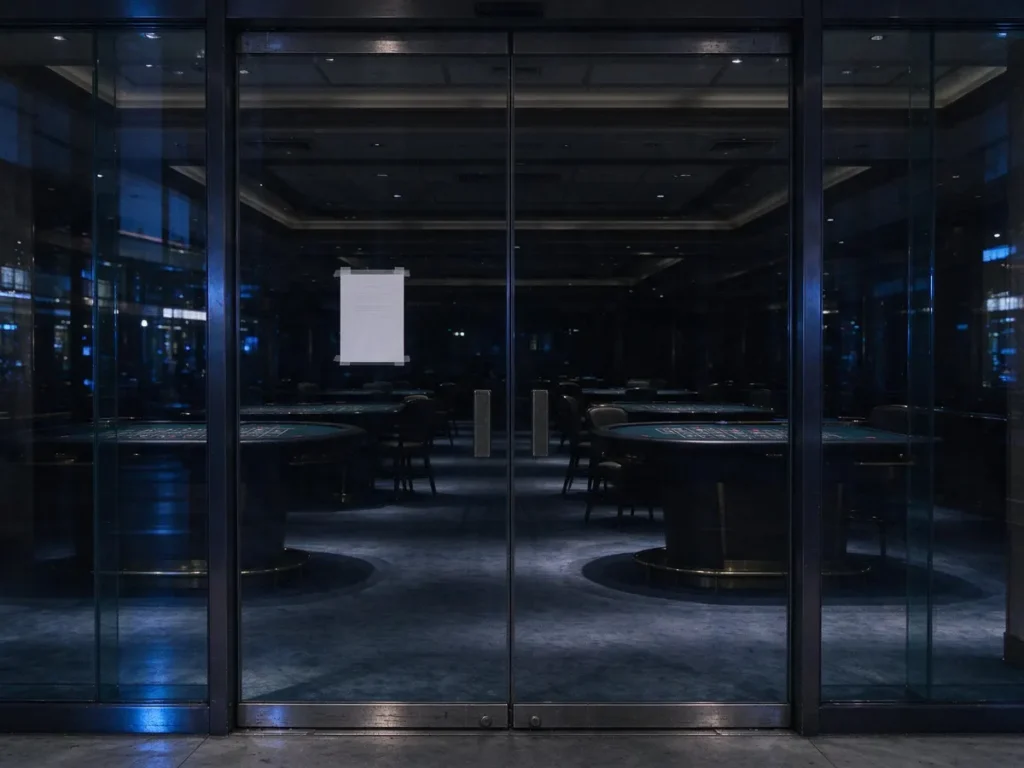
A casino that had barely finished its opening run on Jeju is now dark until the end of the year. The Jeju provincial government has ordered WanLi Casino to suspend operations for two months, through 31 December, with the province pointing to internal management strife and financial difficulties as the likely reasons rather than any breach of its casino licensing conditions. What makes this worth the attention of anyone planning an opening in the region is the timing: the venue had only recently started trading when the order landed, which means its governance and funding were being tested at a point when most project teams have already moved on to marketing.
The timeline, as far as it is documented
The sequence is short and that is the point. WanLi Casino opened recently on Jeju, and within a matter of weeks rather than years the local government issued a suspension order covering roughly two months and ending 31 December. The reporting available describes the venue as recently opened rather than giving a precise opening date, and I am not going to pin one down that the primary notice does not support.
Two months is a specific choice. It is not a warning letter, and it is not revocation. In practice a fixed-term suspension sits in the middle of a regulator’s toolkit: long enough to hurt, short enough to signal that the authority expects the operator to come back into line rather than disappear.
What the local government has said, and what is still not public
The reported basis for the order is internal management strife and financial difficulties at the operator, cited by the Jeju local government as the likely reasons, not non-compliance with the casino’s licensing conditions. The specifics behind either of those phrases have not been spelled out in the coverage I have in front of me, and guessing at them would be worse than useless for an operator trying to learn something from the case. If you are relying on this for a compliance review, pull the provincial notice itself before you draw conclusions about what went wrong inside the company.
That gap matters more than it looks. The difference between a boardroom dispute that paralyses decision-making and a genuine shortfall in working capital changes the remediation work entirely, and it changes how a regulator is likely to behave at the next inspection. Reporting the sanction accurately is easy. Reporting the cause accurately requires the document.
What “suspend operations” actually covers
A suspension order of this kind closes the gaming operation, not necessarily the building. The gaming floor stops: no tables dealt, no machines in play, no gaming revenue recognised for the period. Non-gaming components of a resort, hotel rooms, food and beverage, retail, generally sit under separate business registrations and tourism approvals and are not automatically caught by a casino-specific order, though that depends on the wording of the notice in each case.
The operational consequences are mechanical and predictable:
- Payroll continues for a dealer and supervisory workforce that has nothing to deal, or the operator furloughs staff it spent months recruiting and training.
- Junket, travel-trade and marketing commitments made around an opening calendar have to be unwound or rescheduled.
- Two months of gaming revenue disappear from the ramp-up period, the phase in which a new venue is still establishing baseline volumes and has no historical average to fall back on.
- The suspension itself becomes a disclosed fact that sits in front of lenders, partners and the regulator for years.
The reputational cost is the one operators consistently underweight. A mature property that takes a short suspension is a property with a blemish. A property that takes one in its first season has no track record to set against it, which is a structurally different problem. And where the stated reason is financial difficulty, the closure makes the underlying problem worse by removing the revenue that would have addressed it. Comparisons with how regulated markets elsewhere in Asia behave are instructive here: licensed-market revenue is already volatile enough without self-inflicted closures, as PAGCOR’s reported revenue decline illustrates.
How Jeju can switch a casino off
Casino gaming in South Korea is licensed under the country’s tourism legislation, and Jeju is the unusual case: as a special self-governing province, it holds devolved authority over casino licensing and supervision for venues on the island rather than leaving the function entirely with the national tourism ministry. That is why the order in this case came from the local government and not from Seoul.
Two features of the Korean framework explain how a brand-new venue ends up suspended. First, all but one of the country’s licensed casinos are restricted to foreign passport holders, with Kangwon Land the sole venue open to Korean nationals. A foreign-only licence carries ongoing obligations around patron eligibility and verification that do not exist in open-access markets. Second, the licence is conditional and continuing, not a one-off permission granted at construction. The licensing authority retains graduated sanctions, including fixed-term business suspension and, at the far end, revocation.
So the legal question is not “can a province close a casino it just licensed”. It plainly can. The question is what triggers escalation to a two-month closure when the trigger is the operator’s own management and finances rather than a specific breach on the floor, and that threshold is set by the authority’s own practice rather than by anything an operator can read off a statute.
What a newly opened resort should have locked down
The lesson I would draw from the WanLi case is narrow and practical: a regulator can act on how an operator is run and funded, not only on what happens at the tables. Concretely, before and immediately after the doors open:
- Reconcile every condition written into the licence against evidence you can hand an inspector the same day, line by line, with an owner’s name next to each.
- Confirm that local and provincial approvals are sequenced correctly, including the ones that only bite once the floor is live rather than during fit-out.
- Settle governance before opening: who signs, who decides, and what happens to the operation if the shareholders fall out.
- Assign one accountable person for the regulator relationship who can respond to a notice in hours, and keep a written record of every exchange.
- Model the revenue and payroll impact of a 30, 60 and 90 day closure before opening, so a suspension is a known number rather than a crisis.
What I would not do is build an opening calendar that assumes approval work finishes at the ribbon-cutting, or staff up to full-floor levels on funding that only works if the ramp-up goes to plan.
After December 31
The order runs through 31 December, which tells us when the suspension ends but not automatically what is required to resume. The material available does not specify whether reopening follows automatically at the expiry of the term or depends on the local government confirming that the management and financial problems have been resolved, and I am not going to assume one or the other. Fixed-term suspensions in licensed gaming jurisdictions commonly come with remediation obligations attached; whether Jeju has imposed any here is something to check against the provincial notice.
The open question for everyone else is whether this is enforcement calibration or a one-off. If the province intends the WanLi order as a marker for how closely it will scrutinise the governance and financial standing of newly opened venues, the cost of a shaky ownership structure on Jeju just went up substantially, and any operator with an opening date in 2026 should be reading its own licence again this week.