

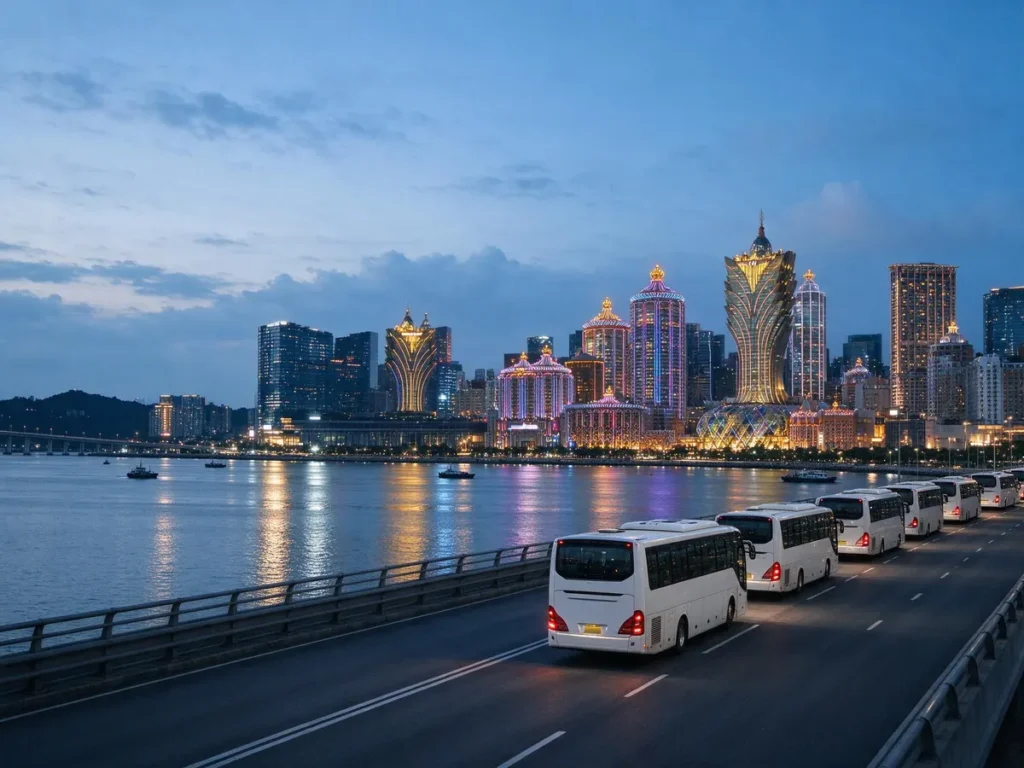
Picture the trip that the arrival statistics are actually counting. A coach clears the Gongbei checkpoint mid-morning. Senado Square, an egg tart, ninety minutes on a mass-market floor somewhere on the peninsula or in Cotai, a photograph outside the Ruins of St Paul’s, and back across the border before the crossing closes. That visitor registers once in Macau’s headline arrival figure. So does the guest who checks into a suite for three nights, eats four restaurant meals, buys a watch and plays premium mass baccarat each evening.
One figure, two completely different businesses. That is the problem buried inside Macau’s 2026 forecast.
Macau tourist arrivals in 2026: what the forecast actually says
The head of the Macao Government Tourism Office has indicated that Macau tourist arrivals could exceed 41 million in 2026, while cautioning that the overnight-visitor segment has so far lagged the wider recovery. The arrivals projection is the bureau’s, not an independent estimate, and the caveat attached to it is the more interesting half of the statement.
For context, Macau recorded about 39.4 million visitors in 2019, the last full pre-pandemic year. A 2026 total above 41 million would therefore sit comfortably above the pre-pandemic benchmark on headcount alone. That is the line that will travel: Macau tourism, fully recovered and then some.
It is also where the evidence starts thinning. The precise full-year totals for the most recent years, and the same-day versus overnight breakdown inside them, come from the Statistics and Census Service (DSEC), which publishes the split monthly. Anyone building a 2026 model should pull those series directly rather than accept a round number from a trade summary, this one included. I am not going to estimate the current overnight share for you, because a plausible-looking percentage invented here would get repeated as fact, and the whole point of the tourism office’s caveat is that the ratio is the variable that matters.
The day-trip engine is doing the heavy lifting
Same-day visitation rebounds faster than overnight visitation because it is cheaper, easier and essentially a commute. Nothing about it requires annual leave, a flight booking or a hotel rate that clears the guest’s budget.
Greater Bay Area connectivity made the trip trivial
Macau sits inside the Greater Bay Area with land and sea connections that have multiplied since 2018. The Hong Kong–Zhuhai–Macao Bridge, the Qingmao crossing, the Hengqin port and the long-standing Gongbei gateway between Zhuhai and the peninsula together turn a visit into something a resident of Guangdong can do between breakfast and dinner. Mainland policy has pushed in the same direction, with the Individual Visit Scheme extended to additional mainland cities and multiple-entry arrangements available to some Zhuhai residents. Each of those changes lowers the friction on a same-day trip far more than it lowers the friction on a three-night one.
Short-haul mainland patterns favour volume over duration
Short-haul mainland traffic also responds quickly to weekends, public holidays and events. A concert, a Grand Prix weekend or a Golden Week produces a visible spike in arrivals, much of it concentrated in a single day. Volume of that kind is genuinely valuable to retail, food and beverage and the mass gaming floor. What it does not do is fill rooms on a Tuesday in March.
Where the overnight segment breaks down
Overnight recovery is constrained by things Macau does not fully control: air access, regional hotel competition, and the economics of a multi-day leisure trip. Each one operates on a slower clock than a border crossing.
Flight capacity and the long-haul gap
Long-haul and non-regional air capacity into the Pearl River Delta has recovered unevenly, and visitors from Southeast Asia, North Asia and further afield are structurally overnight visitors because nobody flies in for a day. When those routes thin out, the loss shows up disproportionately in the overnight column and barely at all in the headline. The same applies to multi-day group tours, which depend on coordinated air, hotel and itinerary supply rather than on one open border.
Hotel supply, pricing and the competition for the second night
Macau’s room inventory expanded substantially through the Cotai build-out, which means supply is not the binding constraint, pricing and demand mix are. Room rates spike hard around events and holidays and soften in between, and a visitor who can be home in two hours has a weak reason to pay a peak rate. Hong Kong, Zhuhai and Shenzhen all compete for the same night, often at a lower price. The second night in Macau has to be earned with something that is not a casino floor, because the casino floor is available to the day-tripper too.
Why arrivals and gaming revenue stopped moving together
A day-trip-heavy visitor base produces strong arrival headlines and comparatively soft per-visitor economics. That is the mechanical link between the tourism office’s caveat and the revenue line, and it is why 41 million arrivals should not be read as a proxy for a 2019-level gaming market.
Mass, premium mass and what is left of VIP
Macau’s revenue composition has already been rebuilt around mass and premium mass since the junket sector contracted sharply following the 2022 regulatory crackdown and the collapse of the largest promoters. VIP baccarat, once the dominant line, is a far smaller share of gross gaming revenue than it was in the previous cycle, and premium mass now carries much of the high-value play. Premium mass behaves like an overnight business: it is hosted, it involves accommodation, it runs across multiple sessions. Grind mass and electronic gaming behave like a day-trip business, shorter sessions and lower average spend per head. Shift the visitor mix toward same-day traffic and you shift the revenue mix down the value ladder, even while headcount climbs.
The non-gaming line is the one that really depends on the second night
Gaming revenue tolerates a day-trip mix. Hotel, food and beverage, retail and entertainment revenue does not, because most of those receipts are generated by a guest who is physically resident in the property overnight.
| Revenue line | Same-day visitor | Overnight visitor |
|---|---|---|
| Mass gaming floor | Yes, short session | Yes, multiple sessions |
| Premium mass / hosted play | Rare | Common |
| Hotel room nights | None | Core |
| Food and beverage | One meal, often off-property | Several, often on-property |
| Retail and entertainment | Occasional | Frequent |
| MICE and group business | Minimal | Dependent on it |
The cost of misreading this is concrete. Index 2026 revenue expectations to a 41 million arrival forecast and you get the direction right and the magnitude wrong, because the marginal visitor in that forecast is cheaper than the average visitor in 2019. The reverse error is just as expensive: price a hotel book for a multi-day market that has not returned, and you discount into occupancy anyway.
What Macau is actually doing about the second night
The policy answer is non-gaming, and it is contractual rather than aspirational. The ten-year concessions that took effect in 2023 obliged all six operators to commit a substantial portion of their investment to non-gaming projects, including entertainment, conventions and exhibitions, sports events and international market development. Concerts and residencies at the Cotai arenas, large-scale sporting events and MICE programming all exist to do the same job: give a visitor a reason to arrive the day before and leave the day after.
Whether that works is still open. An arena show can fill rooms for a weekend without changing the structural ratio across a full year, and international market development runs into the air capacity problem described above. This is a reasonable comparison point for anyone watching other Asian markets build the same case, including MGM’s projection that local residents will make up more than half of visitors to its Osaka integrated resort, where the domestic-versus-visitor mix raises an almost identical set of revenue-composition questions.
The numbers that will settle it
Three series, monthly. DSEC’s visitor arrivals release and its same-day versus overnight split, which is where the tourism office’s caveat either resolves or persists. Average length of stay for overnight visitors, which tells you whether the second night is actually being bought. And the operators’ own quarterly commentary on mass versus premium mass mix and non-gaming contribution, which is where the visitor ratio turns into money.
If arrivals clear 41 million in 2026 and the overnight share is flat, Macau will have recovered its tourism volume without recovering its tourism economy. That is a different story from the one the headline tells, and it is the one worth tracking.