

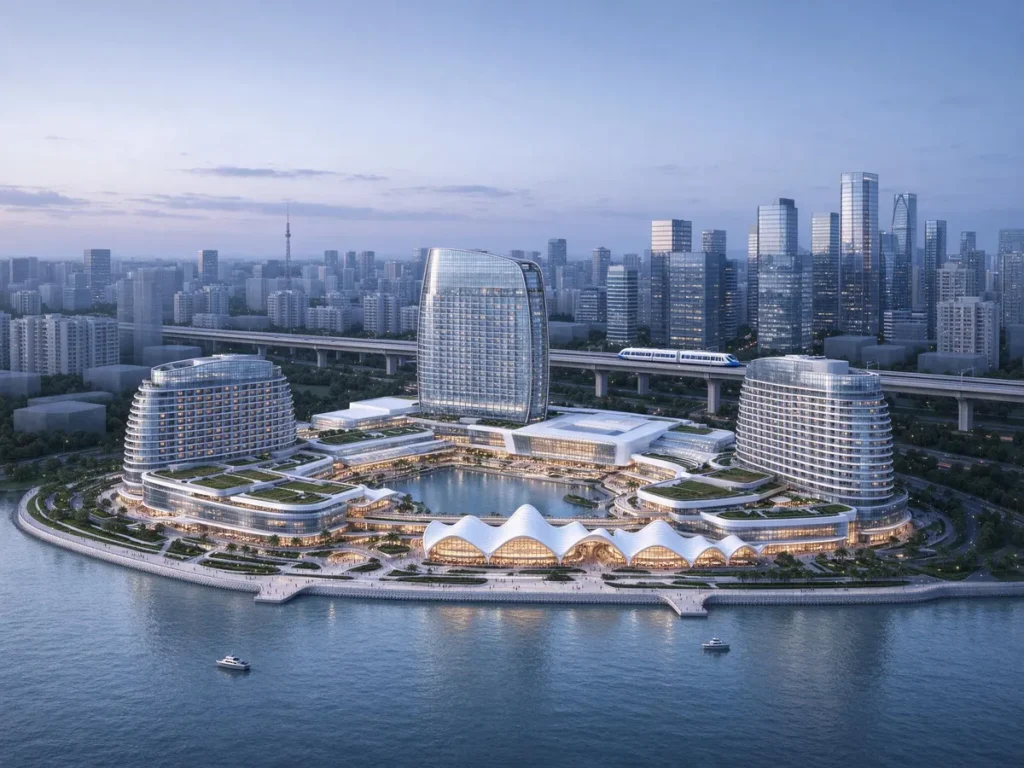
Fifty-four percent. That is the share of visitors MGM Resorts expects to draw from the Osaka region itself once Japan’s first integrated resort opens, according to reporting by trade outlet GGRAsia. For a property being built on the promise of international tourism, the MGM Osaka visitor projections put the majority of footfall in the hands of people who live within commuting distance. That single figure says more about how the resort will have to make money than any gaming revenue forecast released so far.
What MGM Resorts’ visitor projections for MGM Osaka actually say
The stated figure is 54% of visitors from the Osaka region, attributed to MGM Resorts and reported by GGRAsia. That is the claim, and it is worth being precise about its limits: it is a projection for a property that has not opened, made by the operator that is building it, and it describes visitor headcount rather than spend.
The remaining 46% is where the evidence runs out. The reporting at hand does not give a clean split between visitors from other parts of Japan and visitors from overseas, and I am not going to assign a plausible-sounding number to it. Anyone modelling the property should treat the domestic-versus-international balance of that residual as unconfirmed until MGM or the Osaka IR joint venture publishes it. The one thing the 54% does settle is direction: this is a domestic-first asset, by design, not a Macau-style import of foreign demand.
Why a locals-heavy crowd is the logical expectation
Three structural facts make a locals-heavy mix the default outcome rather than a surprise. Osaka Prefecture has a population of roughly 8.8 million, and the wider Kansai region roughly 22 to 24 million, all of it tied together by one of the densest commuter rail networks in the world. The Yumeshima site sits inside that network, not at the end of a long-haul flight.
Second, an integrated resort is mostly not a casino. Japan’s IR Implementation Act caps the gaming floor at 3% of the resort’s total floor area, which means the overwhelming majority of the building is hotel, convention space, retail, dining and entertainment. Convention centres and shopping are regional-catchment businesses everywhere on earth. If you build two million square feet of non-gaming product next to more than 22 million people, most of the people who walk through the door will be local, whatever the casino does.
Third, and this is the part that cuts the other way, Japanese residents face deliberate friction that overseas visitors do not. Japanese nationals and foreign residents of Japan must pay a ¥6,000 entry fee per 24-hour casino admission, and their casino entries are capped at three times in any seven days and ten times in any 28 days. Overseas tourists pay nothing and face no visit cap. So the regulation pushes locals toward the non-gaming side of the resort while leaving the gaming floor relatively more accessible to tourists. The 54% projection and the entry-levy regime are consistent only if you accept that a large slice of those local visits are not casino visits at all.
How this compares with Macau, Singapore and Las Vegas
No established integrated resort hub runs on a majority-local visitor base. Macau has a resident population of roughly 713,000 to 724,000 against tens of millions of annual arrivals, almost entirely from mainland China and Hong Kong; locals are a rounding error in the footfall. Singapore built its two IRs on inbound tourism and then actively taxed local participation, charging citizens and permanent residents a S$150 daily or S$3,000 annual entry levy. Las Vegas draws most of its Strip visitors from out of state and hands the resident market to a separate tier of off-Strip locals casinos operated by companies such as Station Casinos and Boyd Gaming.
| Market | Core visitor base | How local play is treated |
|---|---|---|
| MGM Osaka (projected) | 54% Osaka-region residents | ¥6,000 entry fee; 3 visits per 7 days, 10 per 28 days |
| Macau | Mainland China and Hong Kong arrivals | No entry levy for residents; gaming staff restricted |
| Singapore | International tourists | S$150 daily or S$3,000 annual levy for citizens and PRs |
| Las Vegas Strip | Out-of-state US and international visitors | No levy; residents largely served by separate off-Strip casinos |
What makes MGM Osaka unusual is that it is attempting to be the Strip property and the locals property in one building, under a rulebook written to discourage exactly that.
Footfall is not revenue, and that is the whole argument
A 54% local visitor share tells you almost nothing about where the gross gaming revenue comes from. Tourists are not capped at ten casino entries a month and do not pay to walk in; a single high-spending inbound visitor can outweigh dozens of local convention attendees in gaming terms. It is entirely possible for MGM Osaka to count a majority-local crowd while earning a minority of its gaming revenue from that crowd. Those two sentences are not in tension, and conflating them is the most common error I expect to see in coverage of this figure. The same discipline applies to any operator-published headline number, including the kind of growth figures sportsbook suppliers report each quarter: ask what the metric is actually counting before you build a thesis on it.
If the projection holds, the commercial consequences are fairly clear. Repeat visitation becomes the central metric rather than one-off tourist spend, which favours membership and loyalty infrastructure, season-ticket style entertainment programming and food and beverage that people return to monthly. It also makes the non-gaming side genuinely load-bearing rather than decorative, because the 3% floor cap and the visit limits mean the casino cannot absorb local demand even if management wanted it to. The risk profile shifts too: a domestic base is less exposed to currency swings, airline capacity and geopolitics, and more exposed to Japanese household spending and to any future tightening of the entry rules.
It also puts player-protection design at the centre of the business rather than the margins of it. The entry fee, visit caps and family-requested exclusion mechanisms in Japan’s framework exist precisely because a resort built next to more than 22 million residents carries a different harm profile from one built for tourists who fly home.
Where MGM Osaka sits in Japan’s IR rollout
MGM Osaka is the only integrated resort Japan has licensed. The national government approved the Osaka area development plan in 2023, with MGM Resorts and Orix as the lead partners in the joint venture developing the Yumeshima site, and the project is targeted to open in 2030 after an earlier 2029 goal slipped. Construction and land remediation on the reclaimed island have been the dominant story to date.
What’s next before the doors open
The useful question for the next few years is not whether the 54% is right, but whether MGM ever publishes the matching revenue split. Visitor-mix projections are cheap; a gaming-revenue-by-origin forecast would commit the operator to something testable. Until that appears, the 54% should be read as a statement of positioning, and the one number still missing from Japan’s first integrated resort is the one that actually determines whether the model works.