

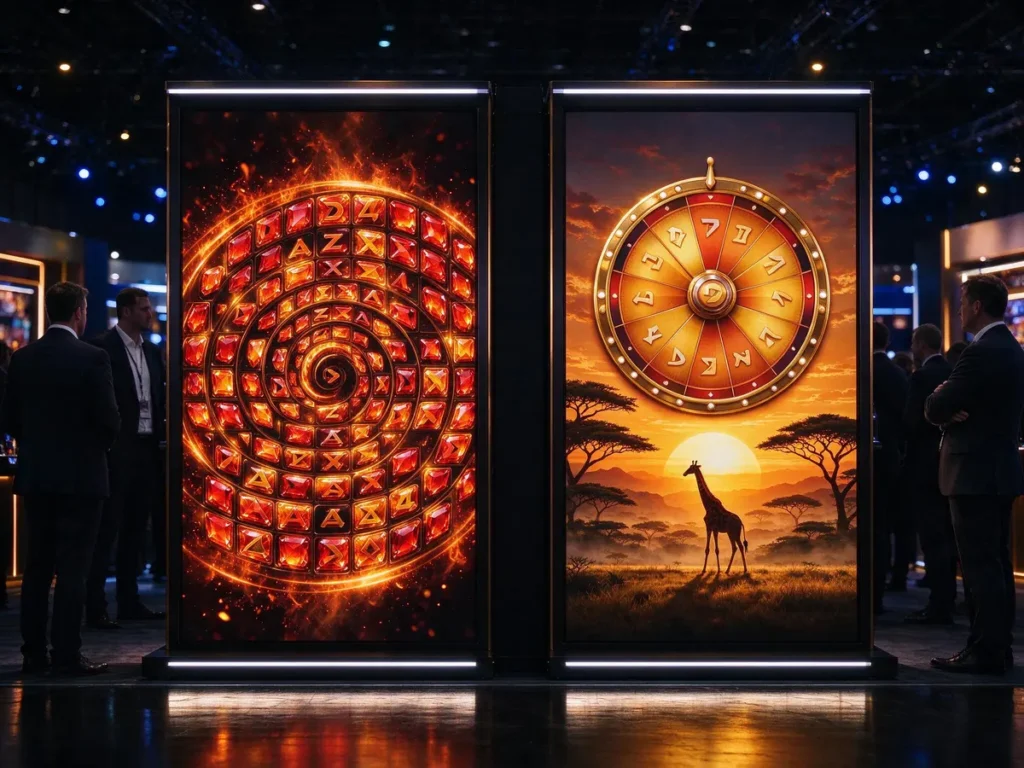
Trade-show stands all work the same way. A screen runs the same forty-second loop from opening to closing, a feature triggers on cue, a big number flashes, and a crowd of operators who have seen four hundred slots this year nod and move on to the next stand. Mancala Gaming took Stand 6043 at SiGMA World in Rome and ran two loops instead of one.
Those two loops are the whole story here, and they are worth a closer look than a trade-show crowd gives them, because the gap between what a demo shows you and what a game actually does to your balance is where most slot fans get their expectations wrong.
What the new slot releases actually are
Mancala Gaming showcased two titles at SiGMA World: Moltar’s Wrath, a high-volatility cluster game played on a spiral grid of 35 symbol positions, and Serengeti Sunrise 2: Magic Wheel, a sequel that keeps the original’s Hold and Win mechanic, with respins, and four fixed jackpots while adding a wheel that awards multipliers or jackpots. Both were on show at Stand 6043.
The two games are pulling in different directions on purpose. Moltar’s Wrath is the swingy, action-heavy entry, built around a grid shape nobody else is using much. Serengeti Sunrise 2 is the safe bet: a follow-up to one of the provider’s better-performing games, with a feature layer added on top of a format players already recognise. Providers almost always pair releases this way at shows, because operators buying for a lobby want one game that looks different and one game that looks like it will retain.
Moltar’s Wrath and the 35-symbol spiral
Moltar’s Wrath drops the reel-and-payline structure entirely and uses cluster pays across a spiral arrangement of 35 symbol positions. Matching symbols pay by forming connected groups rather than by landing left to right on a fixed line.
That matters more for how the game feels than for how it pays. A spiral grid changes which symbols count as adjacent, so clusters form along curves instead of in blocks, and a near miss looks different from a near miss on a 6×5 grid. What it does not change is the underlying maths. Cluster mechanics, Megaways, ways-to-win, old-fashioned 20-line setups: the geometry is a presentation choice layered over a fixed return percentage. A game with an unusual grid is not a game with better odds.
Moltar’s Wrath has been described as a high-volatility, action-packed spiral-grid cluster slot paying up to 5,000x the bet. High volatility means the wins arrive less often and land harder when they do, which is a distribution choice rather than a generosity one. The published RTP is 95%, which puts the house edge at 5% over the long run, a point below the 96% that has become the rough default for mainstream slots. Two cluster slots with the same 35 positions and the same art can still behave completely differently depending on how the wins are distributed.
Serengeti Sunrise 2: Magic Wheel, and what the wheel does
The sequel retains the Hold and Win mechanic, with respins, and four fixed jackpots from the original, and adds a Magic Wheel that can award multipliers or jackpots and boost Special Symbol values during the bonus round, with potential payouts of up to 5,000x the bet.
Hold and Win is Mancala’s take on a familiar family: special symbols lock in place, respins reset on each new landing, and the round ends when the respins run out or the grid fills. The symbols carry cash values, so the round pays out whatever has accumulated on the grid. The Magic Wheel sits on top of that, raising the values of the locked symbols or handing out a jackpot directly.
Worth noting that the four jackpots are fixed, not progressive. Fixed jackpots are set amounts tied to your stake, so they do not swell over weeks of play and they do not produce the seven-figure progressive jackpot payouts that make headlines. In exchange, they hit considerably more often. That trade is the honest version of what a four-tier jackpot ladder is for.
The 5,000x figure, and the number that matters more
A 5,000x maximum win tells you nothing about how much a slot returns, how often it pays, or what it costs to play. It is a ceiling, not a rate. The figure most players should want is the RTP: Mancala has published 95% for Moltar’s Wrath, and no figure has been given for Serengeti Sunrise 2.
This is the misreading worth correcting, because it is close to universal. A max-win number describes the single best outcome the mathematics permits, which in practice is a result most players will never see across a lifetime of spins. The return to player figure describes what the game gives back on average over millions of rounds, and the house edge is simply the rest of it. A slot at 96% RTP keeps about £4 of every £100 wagered over the long run, whatever its ceiling says; at 95%, it keeps about £5.
Two games can both advertise 5,000x and sit a full percentage point apart on RTP. One of those games is measurably more expensive to play than the other, and the marketing material for both will say the same thing. Believing the ceiling is the spec costs you in the dullest way imaginable: you pick the game with the bigger poster number and quietly pay more for the same entertainment.
There is a second variable providers rarely print and operators sometimes set themselves. Some studios ship games with configurable RTP bands, so the same title can run at different returns in different lobbies. Mancala has not said whether these two releases work that way, so treat the 95% as indicative until the game information screen in your lobby confirms it. Check it in the paytable before you spin, not after.
A trade-show reveal is not a release date
Showing a slot at SiGMA World means the game is being sold to operators, not that it is live in anyone’s lobby. Mancala Gaming distributes through casino operators, so when and where you can actually play these titles depends on which operators sign the content deal and which markets they are licensed to serve.
For players in the United States that chain has extra links in it. A provider’s games appear in regulated US lobbies only after the relevant state approvals and operator integrations are in place, and plenty of European-facing studios never make that crossing at all. Nothing in the SiGMA announcement addresses US availability either way, and anyone telling you otherwise is guessing. The useful posture with upcoming slot machines from a show floor is interest without a calendar entry.
That said, show reveals are still the earliest honest look at where slot game themes and mechanics are heading. The pattern across recent new casino games is clear enough: grid shapes are getting stranger, hold-and-win is being layered with wheels and multipliers rather than replaced, and sequels are doing the heavy lifting. It is the same instinct behind Pragmatic Play’s pirate-themed candy slot Sweet Loot, another preview where the headline multiplier arrived well ahead of the full specification.
So the open question is not what Moltar’s Wrath looks like. We know that, and we know what it returns. It is what the sequel returns, how volatile the Hold and Win round is in it, and whether the spiral grid survives contact with players who are not standing at a demo pod in Rome. None of that appears in a press release. It appears in the game information panel, months later, in whichever lobby picks them up.
If you plan to try either title when it lands, set a deposit or session limit first and treat the spend as the price of the entertainment. The ceiling is advertising. The edge is arithmetic.