
What Ontario has actually asked for
A Call for Investment is a government invitation asking private operators to bid for the right to build and run casinos in a defined area. Ontario’s version for the Niagara Region, launched by the provincial government with the Ontario Lottery and Gaming Corporation (OLG), is narrower and far more expensive than that definition suggests. The province will admit up to three new operators initially. Each successful bidder must commit a minimum of C$1.5bn in investment and pay a C$100m entrance fee, and will operate under a new regulatory framework carrying a 9.75 per cent gaming tax. The Niagara casino investment push sits inside the province’s Destination Niagara Strategy and is expected to draw more than C$3bn in direct gaming investment, plus over C$600m in further private-sector investment across the wider tourism plan across 20 years.
Read the brief carefully and one thing becomes clear: this is not a refurbishment programme for the casinos that already stand in Niagara Falls. It is a competitive market opening, and it ends the regional exclusivity held by Mohegan Gaming & Entertainment (MGE). Anyone reading the announcement as “Ontario wants someone to renovate Fallsview” has misread it.
| Term | As announced |
|---|---|
| New operators sought | Up to three initially |
| Minimum investment per operator | C$1.5bn |
| Entrance fee per operator | C$100m |
| Gaming tax rate | 9.75 per cent |
| Expected direct gaming investment | More than C$3bn |
| Additional private tourism investment | Over C$600m |
| Horizon | 20 years |
The two properties already there, and the exclusivity that ends
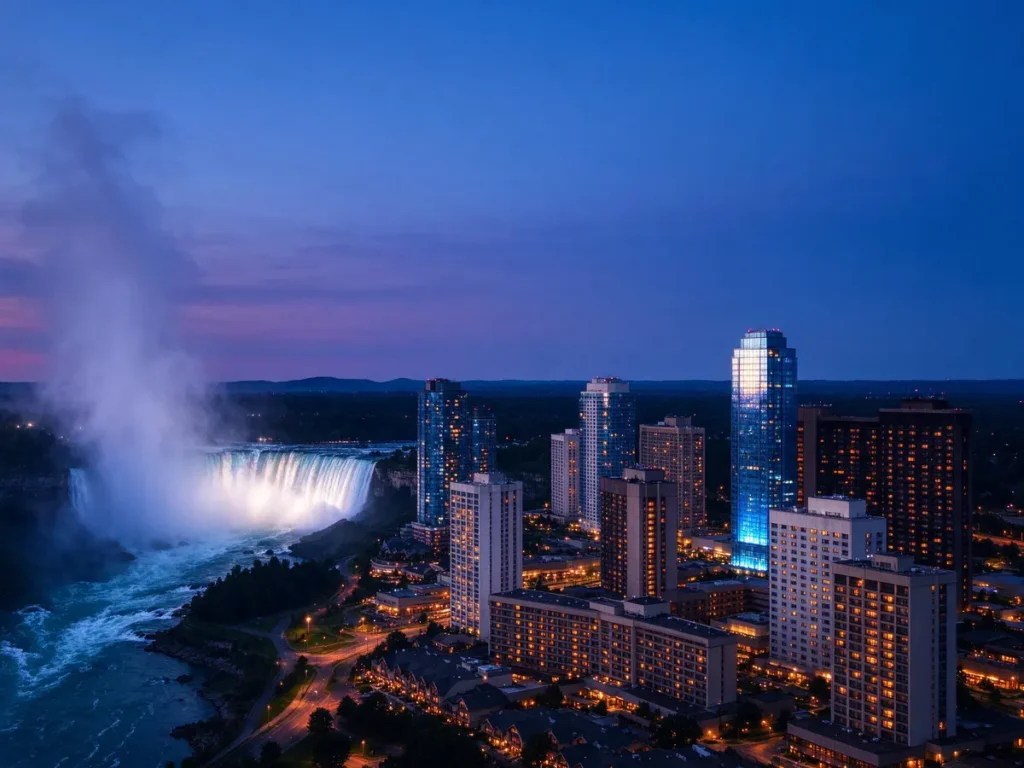
Niagara Falls, Ontario currently has two OLG casino properties: Casino Niagara and Niagara Fallsview Casino Resort. Both sit within OLG’s framework, with MGE running them day to day as the province’s service provider for the region. OLG conducts and manages the gaming; the private partner operates the floor, the hotel and the entertainment programme.
That arrangement has given MGE sole casino presence in the region. The Call for Investment removes it. Three additional licensed resorts in a single border town changes the competitive arithmetic for the incumbent properties more than it changes anything else in the province, and the incumbent’s response is the first thing worth watching. An operator holding exclusivity it is about to lose has two rational options: bid for one of the new positions itself, or reinvest in what it already runs to defend share. Neither is free.
Why the province is moving now
Ontario’s stated reason is tourism development: Niagara is the anchor of the Destination Niagara Strategy, and gaming capital is being used to pull hotel rooms, entertainment venues and visitor spending into the region on a 20-year horizon. The C$600m figure attached to the wider tourism plan is the tell here. Gaming is the mechanism, not the objective.
The competitive context supports the timing even where the province does not spell it out. Niagara Falls is a two-sided destination, and the American side has an established casino resort in Niagara Falls, New York. Visitation on the Canadian side depends heavily on cross-border traffic and on the region’s appeal as a multi-night stay rather than a day trip. Two casinos, one of them decades old in concept, do not carry a multi-night destination on their own. Where I would be cautious is in treating “post-pandemic recovery” as the driver: the published terms describe a long-dated build-out, not a stimulus measure.
The number that decides everything: C$1.5bn against 9.75 per cent
A C$1.5bn minimum build plus a C$100m entrance fee is a US-scale commitment in a market with a Canadian-scale catchment, and the 9.75 per cent gaming tax is the province’s way of making the arithmetic survivable. That rate is low by the standards of most North American commercial gaming jurisdictions, and it has to be, because the entrance fee and capital floor are set high enough to screen out anyone who is not a serious resort developer.
The risk is not subtle. Three new resorts at the minimum spend would mean C$4.5bn of construction, yet the province projects “more than C$3bn” in direct gaming investment. The gap suggests Ontario is not assuming all three positions fill immediately, or fill at once. An investor should read it the same way: the licence count is a ceiling, not a forecast.
The cost of misjudging this falls on the capital, not the Crown. The entrance fee is paid for access to a market whose gaming revenue has to be shared among more properties than it supports today, with win per visit constrained by a regional population that is not growing at the rate of the room inventory. Projected returns on destination gaming assets depend on non-gaming revenue, borrowing costs and visitation that no bidder controls, and nothing in a government call for investment guarantees any of it. The honest framing is that Ontario has set the price of entry and left the demand risk entirely with the bidder.
What it signals about Ontario’s gaming regulation
Ontario is extending to land-based casinos the posture it already took online. iGaming Ontario, the conduct-and-manage body under the Alcohol and Gaming Commission of Ontario, was established on July 6, 2021, and the province’s regulated online gambling market launched on April 4, 2022, with private operators registered to run their own brands inside it. The Niagara framework looks structurally similar: a defined tax rate paid by operators who keep their own gaming revenue, rather than the service-provider fee model that has governed OLG’s casinos since modernisation.
This matters legally as well as commercially. Canada’s Criminal Code allows only provincial governments to conduct and manage gaming, so any “private” casino licence has to be built on top of a provincial conduct-and-manage structure. The reported 9.75 per cent rate implies Ontario has designed one for Niagara. Confirming that framework in legislation and regulation, rather than in a press release, is a precondition for anyone underwriting a C$1.5bn build.
Opening a concentrated market to three more operators also raises the player-protection workload. More floors in one town means more aggressive marketing in one catchment, and the province’s self-exclusion, deposit limit and advertising standards will need to apply uniformly across incumbent and new operators. Ontario’s existing responsible-gambling tools are available to players through AGCO-regulated channels; extending them cleanly to a multi-operator Niagara is a design question the framework has to answer.
How the rest of Canada compares
Every Canadian province runs gaming through a Crown corporation, and most still prefer the service-provider model Ontario is partially stepping away from. British Columbia’s casinos operate under BCLC with private operators running venues; Quebec’s are run directly by Loto-Québec. Alberta has legislated toward a competitive online market along Ontario’s lines, which is the closest parallel elsewhere in the country, though the land-based side remains conventional.
That makes Niagara the most open land-based casino opportunity in Canada by some distance, and the only one currently priced for international resort capital. Investor appetite for Canadian gaming assets has historically been muted precisely because the Crown model leaves operators with fee income rather than revenue ownership. A tax-rate framework changes what the asset is worth on a balance sheet. Whether it changes it enough to attract three bidders at C$1.6bn all-in is the open question.
What a new Niagara resort would plausibly contain
Nothing in the announcement specifies amenities, so treat what follows as industry pattern rather than reported fact. At a C$1.5bn capital floor, a project cannot be a gaming hall. Comparable integrated resorts in North America allocate most of that budget to hotel rooms, convention and meeting space, a mid-sized entertainment venue, food and beverage with outside branded partners, and only a modest share of total floor area to gaming. Destination strategies are written around room nights, and room nights come from conventions and shows.
The capital structure is the more interesting unknown. Operators building at this scale frequently separate property ownership from operations, selling the real estate to a gaming REIT and leasing it back to free up capital for the next build. Gaming REITs have become the dominant landlord class in US casino real estate, and their appetite for new assets is visible in how they deploy cash, as the debate over VICI Properties’ first share buyback versus further acquisitions showed. A Niagara bidder arriving with a REIT partner already lined up would be a signal that the economics have been stress-tested by someone other than the bidder.
What to watch from here
The announcement sets terms, not a published schedule, so the sequence matters more than any date. Watch for four things in order: the formal submission and qualification process OLG runs behind the Call for Investment; the legislation or regulation that gives the 9.75 per cent framework legal form; the identity and number of qualified bidders, which will reveal whether the C$100m entrance fee screened too hard; and MGE’s posture toward its own properties once exclusivity is no longer protecting them.
The point at which this becomes real is not an award announcement. It is the first shovel in the ground on a C$1.5bn build with financing closed, because that is the moment the demand risk Ontario has transferred to private capital stops being theoretical.