

The number in the name is not the number of ways to win
A new tile appears in the lobby reading Greedy For Gold Power Hit 10,000, and the reasonable guess is that 10,000 counts the ways to win. It doesn’t. In Booming Games’ Power Hit naming the figure is a mechanic brand rather than a grid description, and the game’s own maximum win is 5,000x the stake. The actual ways-to-win count in Greedy For Gold is 576 in the base game, rising to 1,944 during free spins.
That gap between what the name implies and what the reels do is the single most useful thing to understand about this release, which went live on 29 October 2026. What follows is a mechanics explainer: how ways-to-win counts are generated, how Greedy For Gold builds its own, and which numbers the launch announcement does not give you. No predictions about outcomes, because nobody writing about a slot can honestly make them.
What Booming Games put on the reels
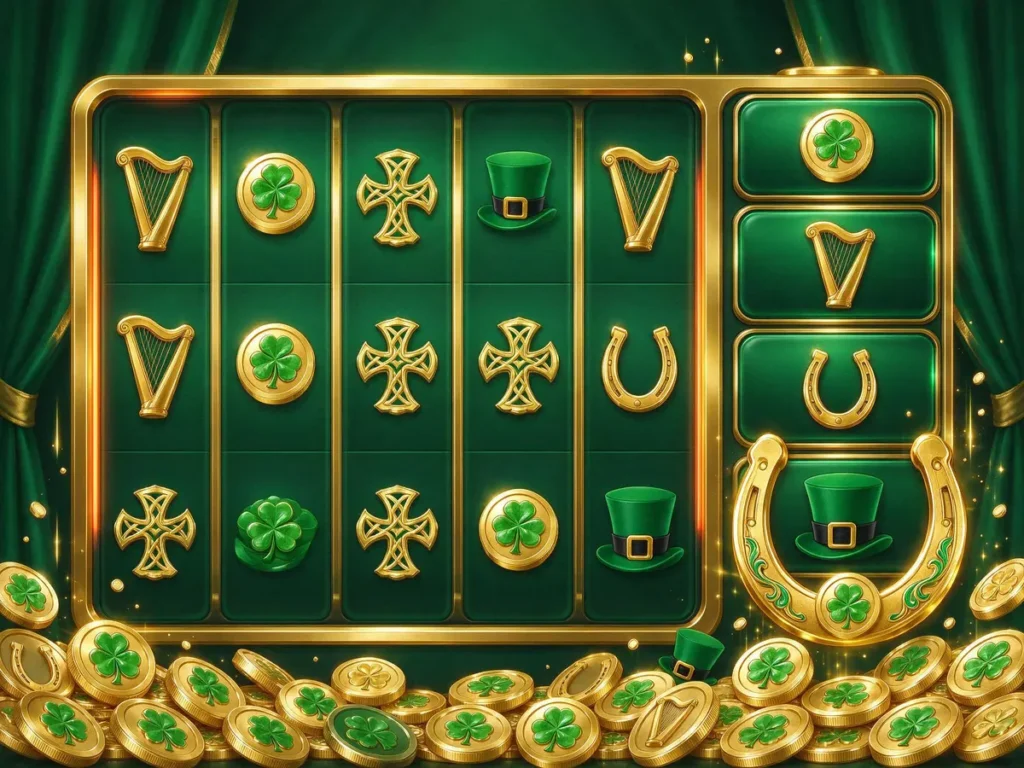
Greedy For Gold is an Irish-themed slot built around two leprechauns, Finn and Fergus, and a coin-collection mechanic feeding four jackpot prizes. From the provider’s launch material, the confirmed pieces are:
- 576 ways to win in the base game, expanding to 1,944 ways in the free spins round.
- A coin-collection mechanic feeding into a maximum win of 5,000x the stake.
- Four jackpot prizes awarded through jackpot coins. Their values climb in the base game as pot symbols land, and sit at maximum throughout free spins.
- Free spins starting at 10 spins, with three further scatters awarding another 10.
Collect-and-upgrade structures of this kind are now standard across studios. If you have played Blueprint Gaming’s Kong Even More Money and its upgrade pots, the shape will be familiar: symbols accumulate during a round, and the value attached to them is what moves, rather than the win lines themselves.
What the announcement does not state is the reel layout, the RTP, the published volatility rating, or the stake range. Those live on the game’s own information screen, and guessing at them from a press release is how misinformation about slots spreads.
How a ways-to-win count is actually generated
A ways-to-win count is the product of the number of symbol positions on each reel. Five reels showing three symbols each gives 3 × 3 × 3 × 3 × 3, which is the 243 ways you see on hundreds of games. Four symbols per reel on five reels gives 1,024. Matching symbols pay when they appear on consecutive reels from the leftmost reel, in any row position, rather than along a drawn line.
Neither 576 nor 1,944 is a clean power of a single row count, so the Greedy For Gold grid does not show the same number of symbols on every reel. The jump from 576 to 1,944 is a factor of 3.375, which means some reels gain symbol positions when free spins begin. The exact configuration producing those counts is not in the launch announcement, and I am not going to reverse-engineer a plausible grid and present it as fact. Check the paytable.
| Structure | Ways to win | How the count arises |
|---|---|---|
| 5 reels, 3 symbols per reel | 243 | 3 to the power of 5 |
| 5 reels, 4 symbols per reel | 1,024 | 4 to the power of 5 |
| Greedy For Gold base game | 576 | Uneven symbol counts across reels; layout not published at launch |
| Greedy For Gold free spins | 1,944 | 3.375x the base count, so reels add positions in the feature |
| Cluster pays | Not counted in ways | Groups of touching symbols anywhere on the grid |
Seen against that table, 576 ways sits below the 1,024 standard, and 1,944 in the feature sits modestly above it. This is not a huge-ways game in the Megaways sense. The number in the title is doing different work entirely.
Paylines versus ways to win, from the player’s seat
The practical difference is where your bet goes and how you read a win. On a fixed-payline game you are often betting per line, and a win has to follow a specific drawn path, so the paytable includes a diagram of every line. On a ways-to-win game you place a single stake for the whole spin, and position within a reel stops mattering: three matching symbols on the first three reels pay regardless of which rows they occupy.
What usually follows is more frequent small combinations, because there are more qualifying arrangements of low-value symbols. What does not follow is a better game. Return to player is set by the paytable as a whole, not by the ways count, and a studio raising the number of ways will normally trim symbol values to keep the maths where it wants them. A game with 1,024 ways and modest symbol pays can return less than a 10-line game with generous ones. The ways count tells you how wins are counted. It tells you nothing about how much is returned.
Volatility, and why a max win figure is not a rating
Volatility describes how a game’s returns are distributed over time: low volatility means frequent, small wins, high volatility means rarer but larger ones, and medium sits between. Hit frequency, which is how often any win lands, is a separate measure from volatility, which is about the size of those wins. Neither changes RTP. A 96% RTP game returns an average of 96 cents per dollar wagered across millions of spins whether it pays in dribs or in rare spikes, and the remaining 4% house edge applies in both cases.
So is Greedy For Gold high or low volatility? The launch announcement does not say, and no honest answer exists outside the game’s published rating. What can be said as general principle is this: when a meaningful share of a game’s return is parked in a top prize of 5,000x, the distribution of outcomes skews, because that money has to come out of the frequency of ordinary wins. A ceiling that high is a signal worth noticing. It is not a substitute for the volatility index the studio publishes on the info screen, and anyone converting it into a rating is guessing.
Before spinning anything new, three numbers are worth thirty seconds of your time: the RTP, the published volatility rating, and the maximum win. Many studios ship games in more than one RTP configuration, with the operator choosing which to run, so the figure in a review is not necessarily the figure in your lobby. Read it where you are playing.
Why studios are branding mechanics with numbers
“Power Hit 10,000” reads as a family name with a figure baked into it, and that is the point of naming it this way. A mechanic brand travels: players who recognise the label know roughly what kind of round they are getting before they open the game, the way Megaways or Hold and Win function as shorthand. Putting a large round number in the title also places the most marketable thing about the release in the lobby tile itself, where a volatility rating never appears.
Whether Booming Games extends the Power Hit line to other ceilings is a question the launch announcement does not answer, and neither does it explain why a game capped at 5,000x carries 10,000 in its name. That is the gap worth holding on to. The broader pattern across 2026’s new slot releases is clear enough though: mechanics are being packaged as products, and the headline number in a title increasingly describes branding rather than a grid. Pragmatic Play went the other way with Pragmatic Play’s Sweet Loot, a 6×5 slot with 96.53% RTP, publishing the layout, the return figure and a maximum win of 10,000x the bet up front.
Reading the paytable is the whole skill
Knowing that Power Hit 10,000 names a mechanic family rather than a ways count does not improve anyone’s chances. It improves something smaller and more useful: the ability to look at a game tile, work out which claims are mechanical descriptions and which are marketing, and then go find the numbers that actually govern the game. Ways counts, collect features and jackpot pots are all structure. RTP and volatility are the terms you are playing under.
Outcomes stay random, each spin is independent of the last, and the house edge is built into every configuration a studio ships. Set a budget you are willing to lose before you open the game, and treat the 5,000x maximum win as the far edge of a distribution rather than a destination.