

Four Queens is building a new Sigma Derby, not restoring an old one
In June 2026, a parade moved west along Fremont Street escorting a single gaming machine between two casinos. That machine was the last Sigma Derby still in public use, and the fact that a casino owner threw it a motorcade tells you most of what you need to know about its status in Las Vegas.
Now there is going to be a second one. A newly manufactured Sigma Derby game is scheduled to debut at Four Queens on Fremont Street next year, according to the Las Vegas Advisor, as reported by casino.org. It would be the first new Sigma Derby placed into service in decades, arriving at a moment when interest in the game has climbed precisely because almost none of the originals survive.
What is Sigma Derby?
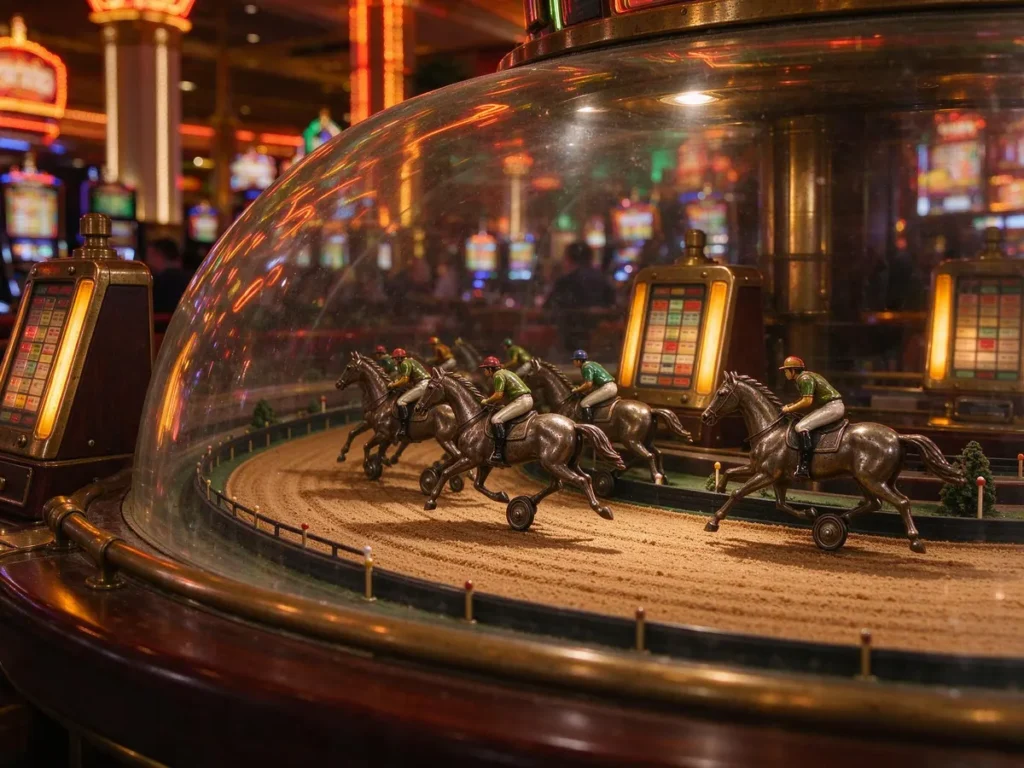
Sigma Derby is an electro-mechanical, communal horse-racing betting game in which miniature toy horses physically race around a small oval track while players bet on the outcome from stations built into the cabinet. The surviving machine has 10 betting stations ringing the track. It was a Las Vegas fixture from the mid-1980s through the late 1990s.
From Sigma Game Inc. to the casino floor
The game was introduced in 1985 by Japan’s Sigma Game Inc. and spread across Nevada casinos through the 1990s. What made it stick was not the payouts. It was that eight or ten strangers stood shoulder to shoulder at the same cabinet, picked different horses, and shouted at plastic figurines for twenty seconds. Traditional slot play is solitary by design. Sigma Derby was the opposite, and that social quality is the thing people actually miss.
How the race plays out, step by step
Here is the sequence at a classic machine:
- You drop your money in at one of the betting stations around the track. The traditional play was a quarter per combination, which is part of why the game drew a crowd rather than a high roller.
- The board posts odds for each possible finish. You are not backing a single horse to win outright. You are picking two of the five horses in the field to come home first and second, which gives ten possible pairings, each with its own price.
- Odds are assigned afresh before every race, so a pairing that paid short last time can be a long shot now.
- Betting closes, the gate opens, and the horses run on the physical track. They surge, stall, and get passed. None of that is choreography you can read.
- The finish order is posted and winning combinations pay at the odds shown when you placed the bet.
Two details are worth getting straight. The first is that the lurching, uneven running of the horses is mechanical presentation, not information: nothing you watch mid-race changes what has already been determined, and no horse is “due”. The second is the word people reach for to describe the betting. It looks like pari-mutuel wagering, all odds boards and tote-style pricing, and casino.org describes the game’s appeal as a blend of mechanical action and pari-mutuel-style wagering. But there is no shared pool of other people’s money setting those prices. It is a gaming device with a built-in theoretical return, which means a house edge, same as the slot next to it. Keep your session money to an amount you are comfortable losing, and treat the quarters as the cost of the show.
Why Sigma Derby nearly went extinct
Moving parts killed it. Sigma Game stopped making the machines, replacement parts became scarce, and the aging mechanisms demanded constant attention from technicians who had fewer and fewer reasons to learn them. A cabinet that occupies the footprint of several slots, takes quarters, and needs a specialist to keep its horses running is a hard case to make to a floor manager comparing revenue per square foot.
So the machines went to storage, to auction, to private collections. And the scarcity did what scarcity does: it turned an obsolete quarter game into a pilgrimage. Retro-gaming fans and classic casino game collectors started tracking the remaining cabinets the way arcade people track surviving cabinets of a dead title. The game got more famous as it got rarer.
Where you can still play one
One machine remains in public use, and it now sits at the Golden Gate in downtown Las Vegas. Its history is a decent summary of the whole problem: it originally ran at the New Frontier, was pulled and put into storage, and stayed there until Derek Stevens’ team tracked it down after he acquired Fitzgeralds in 2011. They restored it and made it the centerpiece of the vintage-themed second floor when the property reopened as The D in 2012.
“When we bought Fitzgerald’s, we wanted to give the second floor a vintage feel,” Stevens told casino.org in 2022. “I always had a special place in my heart for Sigma Derby, and it was perfect for the vibe we were going for.”
In 2026 Stevens moved the game from The D to the Golden Gate, which he also owns, with that Fremont Street parade marking the trip. If you have seen a Sigma Derby anywhere else recently, it was a private collection or a trade show floor. Four Queens’ installation is newsworthy for exactly that reason.
What the new version changes
The reproduction was unveiled at this year’s Global Gaming Expo in Las Vegas, where, per industry reports cited by casino.org, it was faithful enough that some observers assumed they were looking at a restored vintage machine. The look stays. The plumbing underneath does not.
| Feature | Original (1985) | New version |
|---|---|---|
| Maker | Sigma Game Inc. | Next Gaming, with Highbrow Gaming and VSR Industries |
| Appearance | Miniature track, surrounding betting stations | Largely unchanged |
| Money in | Coin operated | Bill acceptance |
| Money out | Coins | Ticket-in/ticket-out |
| Race history | None on the machine | Digital display of previous winning horses |
| Bet denominations | Quarter play | 25 cents to $5 |
| Return to player | Fixed by the machine | Configurable by the operator |
The Four Queens placement is not a coincidence. Property owner Terry Caudill founded and owns Next Gaming, one of the three companies behind the revival, so the casino gets the debut of a machine its owner’s company builds.
Two of those changes deserve a second look. Ticket-in/ticket-out removes the coin hoppers and the hopper jams, which is the single biggest reason the originals disappeared. Configurable return-to-player is the one a nostalgist should think about: operators can set the theoretical percentage, so two identical-looking cabinets in two casinos can hold different amounts over the long run. The horses are vintage. The math is a modern slot’s math, and it is set in an office, not by the race.
What a mechanical horse race says about downtown Vegas
A game that needs a crowd to work only makes sense in a building that wants crowds standing around something cheap. That is a specific bet on identity, and downtown has been making versions of it for years, through casino refits, leadership churn at the Fremont Street Experience and the wider push to sell old-school Vegas as the product rather than the leftovers.
Whether a brand new Sigma Derby draws the same crowd as the rescued one is genuinely unsettled. Part of the Golden Gate machine’s pull is that it is the last of its kind, a survivor with a parade in its past, and you cannot manufacture that. What you can manufacture is the twenty seconds of plastic horses and shouting. If that turns out to be the part people were actually coming for, Four Queens will know fairly quickly, and so will you if you stand at the rail when it opens next year.