

Ten brands used to mean ten booths
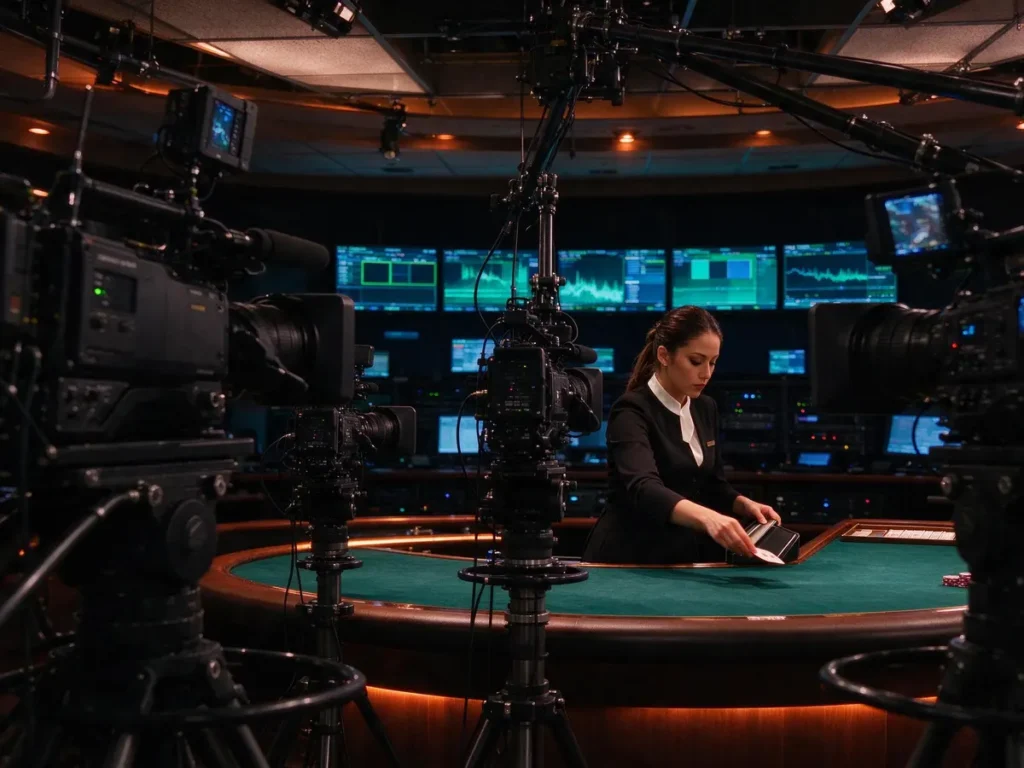
Running ten brands out of one live casino studio once meant ten green-screen booths, each with its own cabling, its own hardware and its own crew, and together they could swallow several hundred square metres of floor. That arithmetic is what made floor space the industry’s favourite proxy for ambition. It was never a proxy for quality. Live casino studio design is decided by camera architecture, streaming infrastructure and dealer discipline, not by total area, and the three of them interact in ways that square metres cannot fix.
The point was made bluntly in recent industry commentary by Chris Strijbosch, VP at nanocosmos, who argues that cloud-based production, real-time translation and multi-brand streaming now let studios serve more markets and more brands without buying more room or more hardware. Worth reading his reasoning on the production side. What follows is the player-facing version: which operational levers actually change what you see, and where they pull against each other.
Why a bigger studio often ships a flatter product
Extra floor area usually buys more tables, not better ones. A studio that doubles in size and keeps the same control room, the same encoding capacity and the same supervisor headcount has doubled its exposure to failure while improving nothing a player can see. The tables at the far end get the same two cameras, the same lighting rig borrowed from next door, and a dealer whose break schedule just got tighter.
Space is not workflow
What matters is adjacency. How far is the table from the control room, how is the camera rig mounted relative to the dealer’s reach, can a supervisor see four tables without walking, can a technician swap a failed encoder mid-shift without taking a feed down. Studios in Armenia, Malta and elsewhere converged on a similar layout for a reason: booths side by side, one per market, dealers speaking different languages, different branding on each feed. The efficiency sits in the arrangement, not the acreage.
What operators optimise for instead
Ask what a table costs to keep live for a year and the priorities reorder themselves fast. Operators optimise for occupancy (how many hours a table is dealt rather than dark), for localisation (native-language dealers and market-specific branding on the same physical table), and for uptime. The old model shipped one table and one background to every market and called it global. The newer one layers brand, language and overlays on a shared feed. More brands now mean more personalisation rather than more rooms, which is the same insight from the other direction: footprint was never the constraint, the production pipeline was.
Camera coverage, lighting and the recognition layer
Visual quality on a live dealer table comes from three things: how many angles cover the action, whether the lighting survives video compression, and whether the game’s state is read by software or only by a human. A quality blackjack or roulette table runs a multi-camera rig, usually at least three feeds, not one locked-off wide shot.
How many angles a table actually needs
The working minimum is a wide shot that establishes the table and dealer, a tight shot on the decision point (the card face, the wheel track and pockets, the shoe), and a third angle that covers chips and the betting layout. Roulette adds a close shot on the ball drop because that is the only moment anyone cares about. Baccarat needs a squeeze-friendly card angle. When a studio runs one camera per table, you get the establishing shot and nothing else, and you end up squinting at a card the dealer has already called.
Lighting that survives compression
Broadcast lighting is the least glamorous line in the budget and the one you notice most. Felt is saturated green, chips are glossy, cards are high-contrast white on dark: that combination eats bitrate. Under flat or uneven light, compression smears card edges and chip denominations into mush at exactly the moment the stream is busiest. Even light across the layout, controlled reflections off the shoe and wheel, and consistent colour temperature between camera angles do more for perceived stream quality than a resolution bump does.
Card and chip recognition
Optical character recognition reads card values and chip placements as they appear and passes them to the game control unit, so results reach the game engine without waiting on a human keystroke. That is a game-integrity feature before it is a convenience one. It timestamps outcomes, reconciles the dealer’s call against what the camera saw, and gives a supervisor something objective to review when a hand is queried. Studios without it lean entirely on dealer accuracy and video playback.
The streaming layer, where most bad sessions actually start
A frozen table is almost never a camera problem. It is encoding, network path or failover. The stream has to arrive fast enough that your betting window is fair, and reliably enough that it does not stall between the dealer’s call and the payout, and those two goals fight each other.
Why latency and buffering happen
Latency is the delay between the real event and your screen. Buffering is the player holding frames back to absorb network jitter. Bigger buffers mean smoother playback and more delay; smaller buffers mean a more responsive table that stutters the moment your connection wobbles. Standard HTTP-based streaming favours the first, which is fine for watching sport and poor for a table where a betting window closes. Low-latency delivery favours the second, which is why a marginal mobile connection often produces micro-stalls on exactly the tables that feel the most responsive when the network is good. There is no setting that wins both, and any studio claiming otherwise is describing ideal conditions. Vendors publish their own latency figures; treat them as targets measured in a lab rather than what you will see on 4G, and check independent industry testing rather than the spec sheet.
Redundancy and what keeps a table live
Uptime comes from duplication: parallel encoders per table, more than one ingest path, servers in more than one region, and automatic failover that moves a feed before a supervisor notices. Mobile-first encoding matters alongside it, because most live tables are now played on mobile devices, and a ladder of bitrates that tops out at desktop quality leaves phone players permanently in the lowest rung. Players are generally advised to use Wi-Fi rather than cellular data for these tables, since an HD video stream running for a full session gets through a lot of it.
Dealer training and game-flow discipline
Standardised procedure is what turns a camera feed into a game you can trust. Dealers are trained to a scripted sequence: the same hand movements, the same announcement wording, cards presented to the designated camera at the designated moment, chips cleared and paid in a fixed order. The script exists so that every round looks identical on video, which is precisely what makes an irregular one visible.
Pacing, rotation and the pit
Pacing is managed deliberately. Betting windows are timed, dealers are rotated on a schedule to keep accuracy from degrading, and a pit supervisor watches a cluster of tables with access to all camera angles. Automatic shufflers remove the slowest and most error-prone part of the cycle from the dealer’s hands and keep deck composition consistent between shoes.
Here is the uncomfortable part, and it does not resolve cleanly. Tight pacing is sold as polish, and it genuinely is: dead air is the most common complaint about a mediocre table. It also raises rounds per hour, and your expected loss is rounds per hour multiplied by average stake multiplied by the house edge. On single-zero roulette that edge is 2.7% of every unit staked, and it does not care how smooth the production is. A beautifully run table with sub-second latency and a dealer who never hesitates is a table you lose money on faster than a sluggish one. Production quality and cost of play move in the same direction, and no amount of studio engineering separates them.
When something goes wrong on camera
Error handling is the clearest signal of a well-run operation. A misdeal, an exposed card, a late bet or a wheel no-spin should trigger a defined procedure: dealer stops, calls the supervisor, the round is voided or corrected per published rules, and the decision is logged against the recorded feed and the game control unit data. Studios that improvise this in front of the camera are telling you what their training looks like off it.
From shuffle to screen, in order
- Cards are shuffled, usually by machine, and loaded into the shoe; the wheel is cleared and the dealer opens the betting window.
- Cameras capture the table from their assigned angles while the lighting rig holds colour and exposure steady.
- Sensors and optical recognition read card values, chip positions and wheel results as they occur.
- The game control unit combines that data with the dealer’s inputs and passes the authoritative game state to the game engine, which settles bets.
- Video and audio go to the encoder, which produces several bitrate renditions for different devices and connections.
- The feed moves through the streaming server and distribution network, with failover paths standing by.
- Your client plays the stream with whatever buffer it can afford, synchronised against the game state so the interface, the result and the payout agree.
Every one of those steps runs in the same facility whether it covers two hundred square metres or two thousand.
What you can actually check from your seat
You cannot audit a studio from a phone, but five things are observable within a few rounds of any table.
| What to watch | Well-run table | Warning sign |
|---|---|---|
| Stream stability | Holds quality through a full shoe or wheel cycle | Repeated resolution drops or stalls at the same points |
| Camera coverage | Card and chip values legible on the close angle | Single wide shot; you rely on the dealer’s call |
| Latency | Betting window closes when the interface says it does | Bets rejected late, or result visible before the window shuts |
| Dealer procedure | Identical sequence and wording every round | Improvised pacing, unannounced corrections |
| Error handling | Supervisor called, round resolved per stated rules | Hand quietly continued or restarted with no explanation |
| Transparency | Rules, shuffle method and licensing details published | No stated procedure for voided rounds or disputes |
Verification language is worth reading closely. Live tables use physical cards and wheels rather than a random number generator, so RNG certification claims apply to the studio’s automated side games or shufflers, not the deal itself. A studio that distinguishes between the two in its own documentation is a studio that understands what it is certifying.
The trade-off at the centre of all this stays open. Everything that makes a live table better to watch also makes it faster to play, and the better the engineering, the less friction stands between you and the next round. Set a deposit or session limit before you sit down, because the production values will not do it for you.