

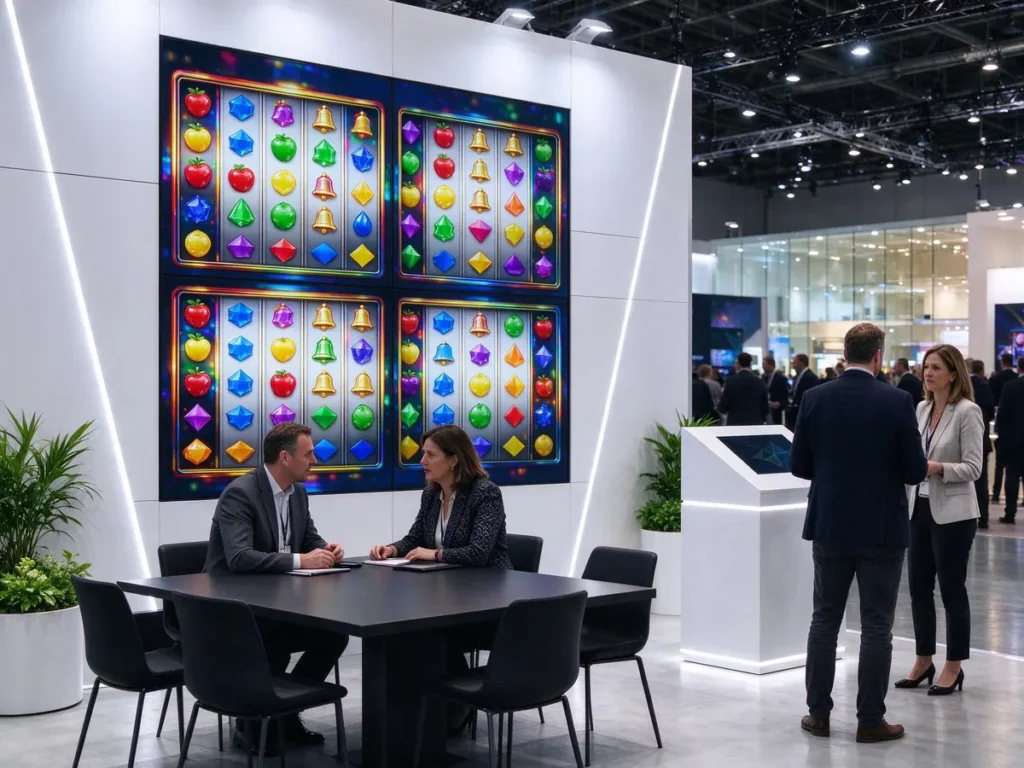
EGT Digital slot games come from a supplier, not a casino you sign up to
At SiGMA World, EGT Digital’s head of sales, Tsvetomira Drumeva, spent the show doing what sales leads at supplier stands do: shoring up the partnerships the company already has and starting new commercial conversations with operators. That matters to players for one reason. EGT Digital slot games do not live on an EGT Digital casino. They reach you only when an operator, or the platform that operator runs on, agrees to carry them.
EGT Digital is a business-to-business supplier, the digital arm of Bulgaria’s Euro Games Technology group. It builds slots and other casino content, plus a sportsbook product and its own platform, branded X-Nave in the interview. Its customers are casino operators and aggregators. Its customers are not you.
That distinction is the whole reason a trade-press interview about “growth markets” is worth a reader’s time, and also the reason most coverage of it misleads. An interview is a statement of intent. It is not a schedule of games arriving in your lobby.
What Drumeva actually said about EGT Digital partnerships
The headline claim from the interview, published by Focus Gaming News, is a direct quote: the company’s objective is to grow both its market presence and the scope of its partnerships. Drumeva framed the SiGMA World appearance as an opportunity to strengthen existing operator relationships and open new commercial discussions across a wide range of markets.
On priorities, the interview points to Latin America, Africa and Europe as expansion targets, and treats Brazil as a question mark rather than a settled opportunity. That nuance is worth holding on to. A supplier naming Brazil as uncertain is telling you the regulatory and commercial picture there is not yet something it will make promises about.
The showcase itself was product-led. Casino titles on the stand included Shield Wall Set Sail, Rabbit Ventura and Ozmo’s Riches, shown alongside sportsbook features such as Bet Builder, Player Props and Early Payouts. Those are the demo reels an operator’s content manager sees before deciding whether to request an integration.
Notice what is absent: no signed operator names, no launch dates, no market-by-market rollout. That is normal for this kind of interview, and it is exactly the gap that gets papered over when the quote gets recycled as “EGT Digital expands into Latin America and Africa.” Stated ambition and completed integration are different events, often separated by many months, and sometimes by a licence that never arrives.
Where a studio like this sits among online slot providers
The online slots supply chain has three layers that players routinely collapse into one. Studios build the games. Aggregators and platform companies bundle hundreds of studios’ games into a single technical feed. Operators run the brand, hold the licence, take the deposits and answer your emails.
EGT Digital sits in the first layer and, through X-Nave, reaches into the second. A studio with its own platform can go to an operator with content alone, or with content plus the system underneath it. White-label casino software and platform deals sit at that same junction: one supplier, several possible shapes of agreement.
None of this tells you a studio is large or small. Slot game studios range from two-person outfits licensing through an aggregator to groups with land-based manufacturing behind them, and public rankings of who leads are mostly marketing. What the structure does tell you is where responsibility lands. The studio certifies the game’s randomness and its maths. The operator decides whether the game appears at all.
Why partnerships, not just games, decide a studio’s reach
A studio can ship a genuinely good slot and have almost nobody play it. Distribution is the constraint. Every new market means a new regulator, often a new technical certification of the RNG, and a sales cycle with operators who already have thousands of titles competing for lobby space. That is why a head of sales talks about “scope of partnerships” rather than game count, and why trade shows still exist in an industry that does everything else remotely.
What a new partnership looks like from your side of the screen
Usually, it looks like nothing. A deal signed in the autumn surfaces as a few unfamiliar thumbnails in the “New games” row some months later, with no announcement anyone outside the industry reads. Sometimes a casino promotes the arrival with free spins on a specific title, which is the clearest public signal that an integration went live.
Two practical consequences follow. First, availability is geographic, not global: a studio licensed for one regulated market may be entirely absent from the same casino brand’s site in another country. Second, the mechanics and maths come from the studio, not the casino. The reels, the features, the volatility and the certified RNG behaviour are built once and served everywhere. What the operator controls is which titles appear, which promotions run, and in some cases which of a game’s configured RTP settings is used, since studios commonly ship slots with more than one. If you care about that number, the game’s own info panel is where you check it, not the studio’s marketing. Our explainer on how RTP and RNG work in online slots covers what that percentage does and does not predict for a single session.
Telling the casino brand apart from the studio that built the game
Open any slot’s information screen. The provider name is printed there, usually with a copyright line and sometimes a licence number, and it is almost never the casino’s name. The game lobby’s filter menu does the same job faster: casinos list providers as a filter precisely because players look for specific studios.
Knowing which is which changes who you complain to. A game that freezes mid-spin or settles a round oddly is a studio or integration matter, escalated through the operator. A withdrawal that stalls, a bonus term that bites, a KYC request that goes nowhere: all operator, all the time, and no studio will intervene. Readers who blur the two tend to aim their frustration at whichever name is larger on the screen, which is the one least likely to be responsible.
Every supplier is running the same play right now
EGT Digital’s stated strategy is unremarkable in the best sense: broaden the partner base, enter newly regulated markets, show the catalogue to operators in person. Sportsbook and casino technology suppliers across the sector are doing the same thing, often by hiring regional sales leads first, the way Digitain’s appointment of an Italy sales lead signalled wider sportsbook expansion. Others lead with localisation of content rather than headcount.
What none of these announcements settle is whether the deals land. The honest reading of this interview is that EGT Digital wants more partners in Latin America, Africa and Europe, is cautious about Brazil, and brought three new slots to a trade show to help make that case. Whether its games show up in your lobby depends on an operator you have never heard of making a decision you will never see. Check the provider filter in six months; that is the only evidence that counts.
Whatever appears there, treat slots as paid entertainment with a built-in house edge, set deposit and time limits before you play, and use the operator’s self-exclusion tools if play stops feeling like a choice.